The ability to maintain concentration and mental clarity can be influenced by many factors.
In children and adolescents, difficulty maintaining attention is often linked to a genuine condition called Attention Deficit Hyperactivity Disorder (ADHD). In Italy, according to 3 epidemiological studies, the frequency of these disorders is around 4% (in practice, 1 child in every class of 25 pupils) [5].
Another factor that can have a major impact on attention and concentration is the excessive use of technology. In particular, several studies have shown that excessive use of the smartphone as a leisure activity can lead to a more superficial approach to things, a drop in concentration and a tendency to be easily distracted.
All this, especially in adolescents, has a negative effect on school performance and, more generally, on learning [6].
In adults, cognitive abilities are mainly influenced by lifestyle, alcohol use and smoking, stress and by pathophysiological conditions such as metabolic alterations and obesity.
In particular, there is a strong correlation between obesity and impaired cognitive function in middle age. It is likely that increasing age, combined with the negative metabolic consequences of obesity (for example type 2 diabetes mellitus), contributes significantly to cognitive decline and to the incidence of dementia. [7]
Memory problems are also frequently associated with depressive states. During a depressive episode, in fact, the ability to concentrate and the speed of reasoning are greatly reduced. In some extreme cases, this can even lead to the development of pseudodementia [8].
Chronic stress is a condition to be avoided and one to watch very carefully when it sets in, because it can lead to numerous negative consequences: it can induce depression, and this state can in turn cause memory deficits [9].
In old age, the progressive loss of certain intellectual functions is very common, and this mild initial condition often turns into degenerative diseases.
One of the features of these diseases is the presence of an inflammatory state in the brain. Inflammation in this area, although mediated by the same molecules that act in inflammatory processes in all other parts of the body, has particular characteristics [10].
The most common neurodegenerative forms are:
Alzheimer’s disease, which affects 5% of the population over the age of 60[11];
frontotemporal dementia, once known as Pick’s disease, which affects younger people than Alzheimer’s, generally between the ages of 55 and 65. 1 in 10 cases of dementia is of the frontotemporal type[12];
Lewy body disease, which is the third most common dementia and generally appears after the age of 60[13].
To reach old age in good health, it is essential to take care of your body, and your mind in particular, from a young age. As the saying goes, “Prevention is better than cure”, so we can take simple daily actions to protect our body:
- follow a varied and balanced diet,
- supplement your diet with high-quality natural products,
- cut out smoking and alcohol,
- keep sources of stress in check,
- take regular, appropriate physical exercise, which also helps to release nervous tension,
- limit digital technology to productive use and avoid using it excessively as a distraction.
In this way, we limit the stimuli that can induce systemic inflammatory states and protect all our organs.
EXPERIMENTAL PHYTOTHERAPY
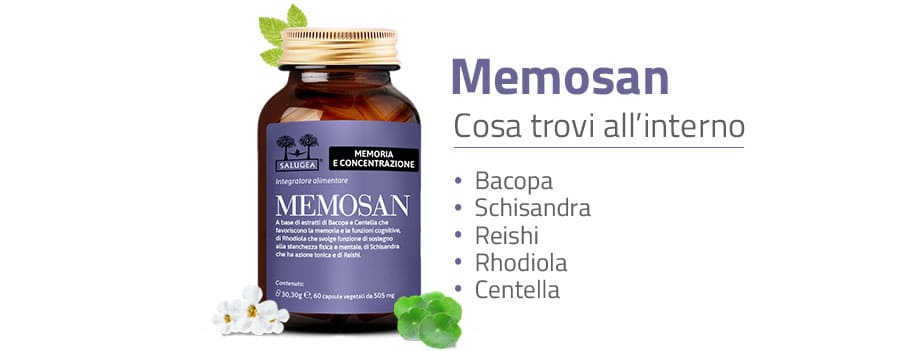
The plants and mushrooms used in Memosan have been used since ancient times as natural remedies for a variety of needs.
Over the years, more and more evidence has been gathered on the use of these plants in experimental phytotherapy.
BACOPA
- Uabundit N, Wattanathorn J, Mucimapura S, Ingkaninan K. Cognitive enhancement and neuroprotective effects of Bacopa monnieri in Alzheimer's disease model. J Ethnopharmacol. 2010 Jan 8;127(1):26-31. doi: 10.1016/j.jep.2009.09.056. Epub 2009 Oct 4. PMID: 19808086.
Bacopa monnieri is a plant already used in Ayurvedic medicine to improve attention and long-term memory. More recently, further studies have been carried out to assess its neuroprotective properties. Bacopa has been found to have positive effects on cognitive function and neuroprotection in in vivo and in vitro models of Alzheimer’s disease. For this reason, Bacopa could be of help in preventing the onset of Alzheimer’s.
- Calabrese C, Gregory WL, Leo M, Kraemer D, Bone K, Oken B. Effects of a standardized Bacopa monnieri extract on cognitive performance, anxiety, and depression in the elderly: a randomized, double-blind, placebo-controlled trial. J Altern Complement Med. 2008;14(6):707-713. doi:10.1089/acm.2008.0018
This study, published in 2008, found that Bacopa has the potential to safely support cognitive performance and emotional wellbeing in ageing. Its effects are mainly due to molecules called Bacosides.
CENTELLA
- Wattanathorn J, Mator L, Muchimapura S, Tongun T, Pasuriwong O, Piyawatkul N, Yimtae K, Sripanidkulchai B, Singkhoraard J. Positive modulation of cognition and mood in the healthy elderly volunteer following the administration of Centella asiatica. J Ethnopharmacol. 2008 Mar 5;116(2):325-32. doi: 10.1016/j.jep.2007.11.038. Epub 2007 Dec 4. PMID: 18191355.
Centella asiatica is a plant native to the Asian continent and is typical of the Indian medical tradition.
This study, published in 2007, in which all the participants were elderly, found that taking Centella extract for two months led to improvements in both cognitive function and mood. These results suggest that the extract of this plant may be a valuable support during mental ageing.
RHODIOLA
- Cropley M, Banks AP, Boyle J. The Effects of Rhodiola rosea L. Extract on Anxiety, Stress, Cognition and Other Mood Symptoms. Phytother Res. 2015 Dec;29(12):1934-9. doi: 10.1002/ptr.5486. Epub 2015 Oct 27. PMID: 26502953.
Rhodiola rosea is used above all for its tonic and adaptogenic properties.
However, this plant also offers further benefits.
This study, conducted on 80 moderately anxious people, showed that the half of the group given Rhodiola rosea had, after 14 days, achieved an improvement in their levels of stress, anxiety and depression and an overall improvement in mood.
SCHISANDRA
- Xu, Xiao, et al. "Schizandrin prevents dexamethasone-induced cognitive deficits." Neuroscience bulletin5 (2012): 532-540.
In addition to Bacopa, Schisandra also has a neuroprotective effect, especially against damage induced by glucocorticoids. This is a mechanism that can support brain function when it is subjected to functional and environmental stress.
- Lin H, Zhang X, Liu J, Yuan L, Liu J, Wang C, Sun J, Chen J, Jing S, Li H. Schisantherin A improves learning and memory abilities partly through regulating the Nrf2/Keap1/ARE signaling pathway in chronic fatigue mice. Exp Ther Med. 2021 Apr;21(4):385. doi: 10.3892/etm.2021.9816. Epub 2021 Feb 23. PMID: 33680107; PMCID: PMC7918174.
This study on mice assessed the effects of Schisantherin A (a molecule found in schisandra extract) under conditions of chronic fatigue, and found that this molecule is able to promote learning and memory abilities in this situation.
REISHI
- Sanodiya BS, Thakur GS, Baghel RK, Prasad GB, Bisen PS. Ganoderma lucidum: a potent pharmacological macrofungus. Curr Pharm Biotechnol. 2009 Dec;10(8):717-42. doi: 10.2174/138920109789978757. PMID: 19939212.
As mentioned above, Reishi or Ganoderma lucidum is a mushroom with a great many bioactive components. These active compounds have been reported to have a range of pharmacological effects.
The main properties include:
- immunomodulatory,
- anti-atherosclerotic,
- anti-inflammatory,
- antioxidant and anti-ageing.
All these properties mean that the nervous system is supported in all its functions. It is indeed very important to protect the brain from premature ageing and from inflammatory states. This protective effect helps to promote intellectual functions even during periods of greater stress and strain, such as intense study and conceptual work.
[1] Kongkeaw C, Dilokthornsakul P, Thanarangsarit P, Limpeanchob N, Norman Scholfield C. Meta-analysis of randomized controlled trials on cognitive effects of Bacopa monnieri extract. J Ethnopharmacol. 2014;151(1):528-35. doi: 10.1016/j.jep.2013.11.008. Epub 2013 Nov 16. PMID: 24252493.
[2] Sowndhararajan K, Deepa P, Kim M, Park SJ, Kim S. An overview of neuroprotective and cognitive enhancement properties of lignans from Schisandra chinensis. Biomed Pharmacother. 2018 Jan;97:958-968. doi: 10.1016/j.biopha.2017.10.145. Epub 2017 Nov 7. PMID: 29136774.
[3] Xu, Xiao, et al. "Schizandrin prevents dexamethasone-induced cognitive deficits." Neuroscience bulletin 28.5 (2012): 532-540.
[4] Sanodiya BS, Thakur GS, Baghel RK, Prasad GB, Bisen PS. Ganoderma lucidum: a potent pharmacological macrofungus. Curr Pharm Biotechnol. 2009 Dec;10(8):717-42. doi: 10.2174/138920109789978757. PMID: 19939212.
[5] Epicentro - Istituto Superiore di Sanità - Sindrome da deficit di attenzione - Aspetti epidemiologici [Attention deficit disorder - Epidemiological aspects]
[6] Fondazione Veronesi - Vaccini e vaccinazioni. Perché sì. Le risposte della scienza. [Vaccines and vaccinations. Why yes. The answers of science.] Fabio Di Todaro.
[7] Dye L, Boyle NB, Champ C, Lawton C. The relationship between obesity and cognitive health and decline. Proc Nutr Soc. 2017 Nov;76(4):443-454. doi: 10.1017/S0029665117002014. Epub 2017 Sep 11. PMID: 28889822.
[8] Neurologia.it Disturbi della memoria - un sintomo e molte cause. [Memory disorders - one symptom, many causes] by Dr Reinhard Prior - Specialist and Lecturer in Neurology
[9] Dillon DG, Pizzagalli DA. Mechanisms of Memory Disruption in Depression. Trends Neurosci. 2018 Mar;41(3):137-149. doi: 10.1016/j.tins.2017.12.006. Epub 2018 Jan 10. PMID: 29331265; PMCID: PMC5835184.
[10] Istituto di Ricerche Farmacologiche Mario Negri Le malattie neurodegenerative: quali sono i sintomi e le cure? Come prevenirle? [Neurodegenerative diseases: what are the symptoms and treatments? How can they be prevented?] Dr Gianluigi Forloni.
[11] OMAR: Alzheimer
[12] MSD Manual - Frontotemporal Dementia - By Juebin Huang, MD, PhD, Department of Neurology, University of Mississippi Medical Center
[13] MSD Manual - Lewy Body Dementia and Parkinson Disease Dementia - By Juebin Huang, MD, PhD, Department of Neurology, University of Mississippi Medical Center
Our texts are for information purposes only; they are not to be understood as an indication for the diagnosis and treatment of medical conditions and are in no way intended to replace the advice of a doctor.