The ever more hectic pace of life, the fears generated by uncertainty about the future [1], and the commitments and events of everyday life put our nerves to the test more and more often.
All this leads to a state of continuous stress which, in the long run, can give rise to anguish, anxiety, pessimism, emotional hyper-reactivity, palpitations, a feeling of tightness in the chest and even breathing difficulties or musculoskeletal blocks in the neck, shoulders or back 2
And to think that stress started out as a positive mechanism!
The word stress literally means strain and, from a “physiological” point of view, it refers precisely to the effort the body makes to adapt to an event, whether external or internal, that is capable of upsetting its adaptive balance.
It’s a very useful mechanism because it allows us to switch from a state of calm to a state of alert in a matter of seconds. And if you think of our ancestors, who could suddenly find themselves faced with a predator ready to hunt them down, it’s easy to see how useful these functions were for literally saving their skin.
Positive stress is known as Eustress.
So, generally speaking, our body doesn’t struggle much to adapt to new events, because it has a great (and natural!) capacity for adaptation.
Coming back to the present day, we can see the adaptation mechanism at work in our brains, which in just a few years have adapted to the electromagnetic waves from smartphones and Wi-Fi networks. And our ears have learned to do the same with the deafening noise typical of big cities, which those who live there no longer even notice.
The problem starts when the stress factors we are exposed to become too many and we can no longer manage them as we should.
At this point, body and mind enter a state of constant alarm. Eustress has become Distress [3].
And it is precisely this form of stress that triggers all the discomforts we mentioned at the beginning.
Over the years, in fact, phytotherapy has increasingly studied these conditions, and several studies bear witness to the importance of a natural approach too.
In the next section we’ll look at some of them and understand how and why plant-based active ingredients can be useful for supporting mood and promoting wellbeing and mental relaxation.
Experimental Phytotherapy
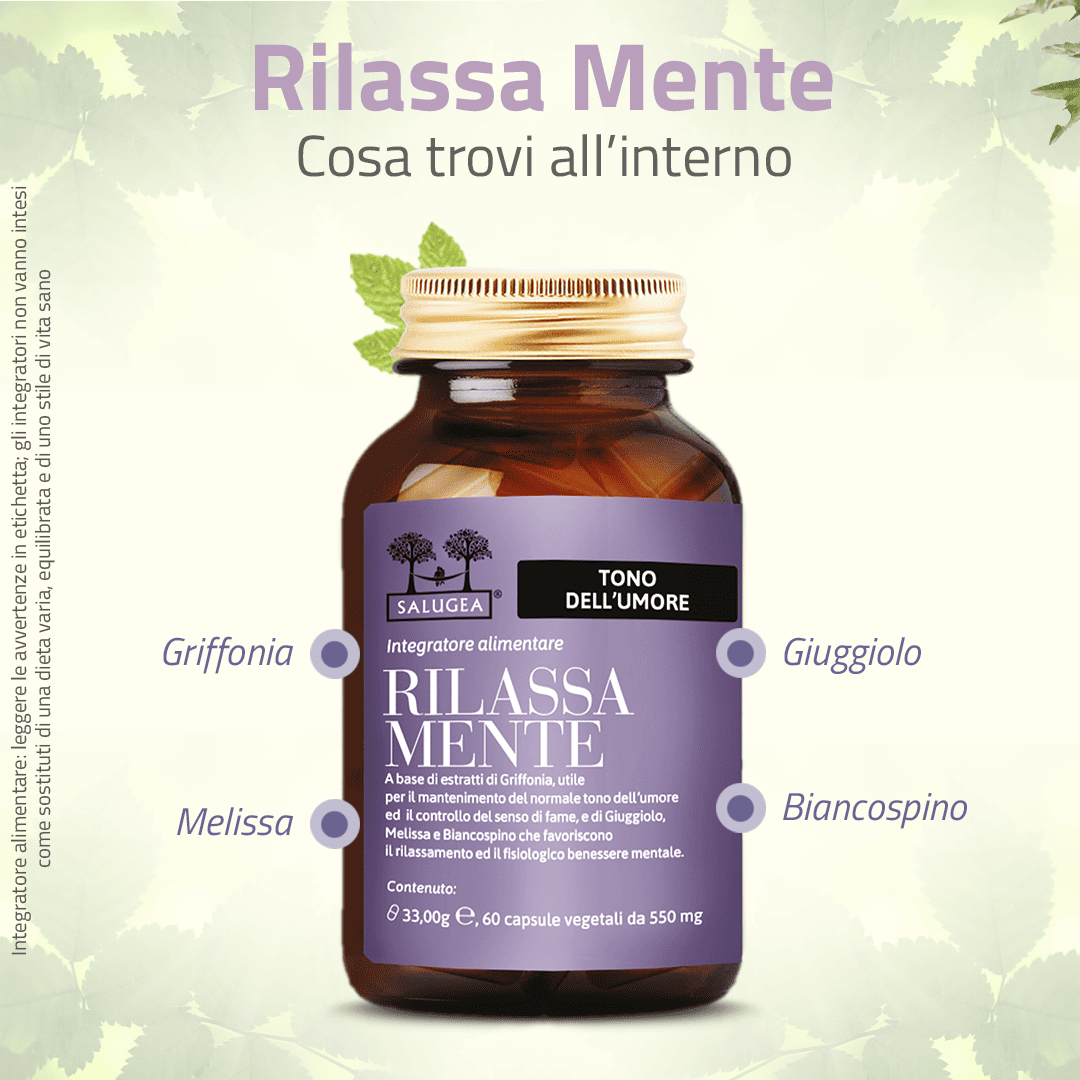
Griffonia
- 2011 Jul 15;18(10):848-51. doi: 10.1016/j.phymed.2011.01.016. Epub 2011 Feb 25. Anxiolytic-like effect of Griffonia simplicifolia Baill. seed extract in rats G Carnevale, V Di Viesti, M Zavatti, P Zanoli
This study, carried out on rats, analyses the anxiolytic effect of Griffonia simplicifolia extract. The premise of the study is Griffonia’s ability to promote serotonin synthesis thanks to the 5-HTP contained in the seeds of the fruit.
The results of the trial indicate that Griffonia simplicifolia seed extract has a significant anxiolytic effect, and its use is suggested for emotional imbalances such as anxiety and stress.
- An open-label trial of L-5-hydroxytryptophan in subjects with romantic stress. Emanuele E, Bertona M, Minoretti P, Geroldi D. Neuro Endocrinol Lett. 2010;31(5):663-6.
In this study, the researchers assessed the effectiveness of Griffonia extract in subjects with emotional problems or who had recently gone through the break-up of an important relationship. The study, which lasted 6 weeks, involved both men and women. The researchers observed an improvement in their stress levels. The data suggest that direct modulation of the serotonergic system, thanks to Griffonia, may be useful in treating the psychological distress associated with emotional trauma.
Jujube
- Comparison of the sedative and hypnotic effects of flavonoids, saponins, and polysaccharides extracted from Semen Ziziphus jujube. Jiang JG, Huang XJ, Chen J, Lin QS. Nat Prod Res. 2007 Apr;21(4):310-20.
This study, conducted on mice, compares the sedative and hypnotic effects of flavonoids, saponins and polysaccharides, all extracted from Jujube
The comparative analysis showed that saponins have a more effective sedative and hypnotic action than flavonoids. Polysaccharides showed no sedative or hypnotic effects.
- 2017 Apr;18(2):263-273. doi: 10.1007/s10522-017-9686-8. Epub 2017 Mar 1. Jujube (Ziziphus Jujuba Mill.) fruit feeding extends lifespan and increases tolerance to environmental stresses by regulating aging-associated gene expression in Drosophila Saurav Ghimire, Man Su Kim
This study analyses, in an animal model, how taking Jujube increases tolerance to environmental stresses. The researchers showed that feeding with Jujube not only extends lifespan but also improves its quality, as assessed by indicators such as stress and hunger.
Lemon Balm
- Melissa officinalis L. - A review of its traditional uses, phytoche- mistry and pharmacology. Shakeri A, Sahebkar A, Javadi B. J Ethnopharmacol. 2016 Jul 21;188:204-28. doi: 10.1016/j.je- p.2016.05.010. Epub 2016 May 7. Review.
With this review, the researchers aimed to provide an overview of the botanical characteristics, uses and possible adverse effects of Melissa officinalis.
Publications (online and in print) written between 1956 and 2015 on the pharmacology and phytochemistry of Melissa officinalis were collected.
The studies examined showed that Lemon Balm, thanks to its components (volatile compounds, triterpenoids, phenolic acids and flavonoids), has anxiolytic and antispasmodic properties. Effects on mood, cognitive function and memory have also been demonstrated.
The researchers conclude that Lemon Balm is a very important plant for the treatment of a wide range of disorders, particularly anxiety and other imbalances of the central nervous system.
- Pilot trial of Melissa officinalis L. leaf extract in the treatment of volunteers suffering from mild-to-moderate anxiety disorders and sleep disturbances. Cases J, Ibarra A, Feuillère N, Roller M, Sukkar SG. Med J Nutrition Metab. 2011 Dec;4(3):211-218. Epub 2010 Dec 17.
This is a study that analyses the effects of Melissa officinalis as a treatment for mild-to-moderate anxiety and sleep disorders. The study participants, male and female volunteers suffering from these disorders, underwent the trial for 15 days.
The results were extremely positive. 95% of subjects responded positively to the treatment. Of these, 70% achieved complete remission from anxiety, 85% from insomnia and 70% from both.
Hawthorn
- Curr Med Chem . 2018;25(37):4854-4865. doi: 10.2174/0929867323666160919095519. Phytochemical and Pharmacological Activity Profile of Crataegus oxyacantha L. (Hawthorn) - A Cardiotonic Herb Ilkay Erdogan Orhan
This study starts from an analysis of other studies which have shown that Hawthorn contains oligomeric procyanidins and various types of flavonoids/flavonols, considered the main groups of active substances, together with phenolic acids, triterpenes, fatty acids and sterols that are useful for heart and cardiovascular wellbeing.
In detail, the study mainly aims to outline the cardiotonic effect of Hawthorn and its phytochemical properties. Thanks to its characteristics, Hawthorn has proved useful in promoting coronary blood flow, as an antioxidant and in its cardioprotective activity, since it supports normal heart function.
[1] Giallonardo V, Sampogna G, Del Vecchio V, et al. The Impact of Quarantine and Physical Distancing Following COVID-19 on Mental Health: Study Protocol of a Multicentric Italian Population Trial. Front Psychiatry. 2020;11:533. Published 2020 Jun 5. doi:10.3389/fpsyt.2020.00533
[2] Southwick SM, Vythilingam M, Charney DS. The psychobiology of depression and resilience to stress: implications for prevention and treatment. Annual Review of Clinical Psychology. 2005 ;1:255-291. DOI: 10.1146/annurev.clinpsy.1.102803.143948. PMID: 17716089.
[3] Huffingtonpost.it - Eustress e distress - Mario Furlan 29/09/2014.
Our texts are for information purposes only; they are not to be understood as an indication for the diagnosis and treatment of medical conditions and are in no way intended to replace the advice of a doctor.