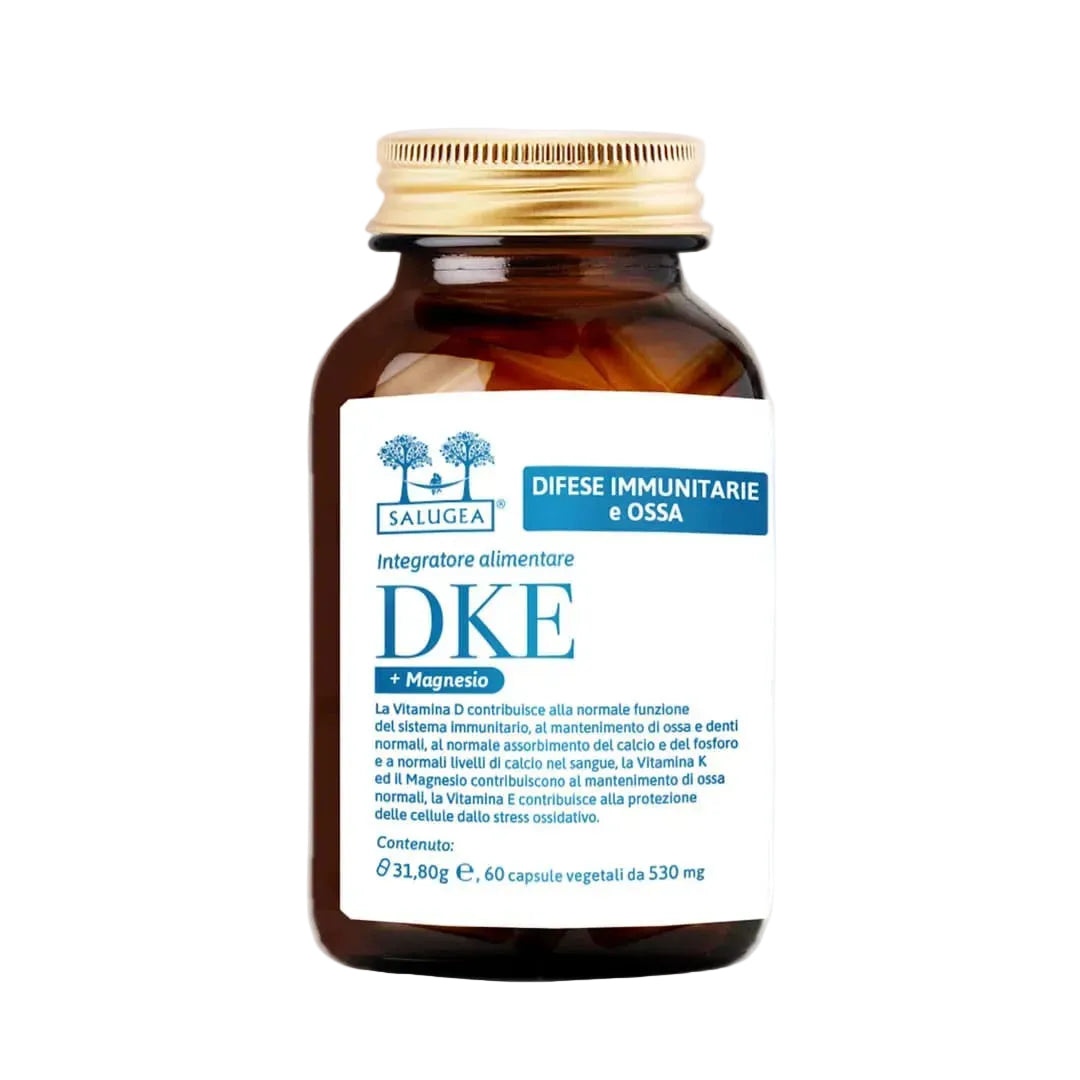
IMPORTANT NOTE ON TAKING VITAMIN D WITH VITAMIN K
Regarding the claim that vitamins D and K cannot be taken together, we would like to clarify the following.
Vitamins D and K have completely different metabolic pathways, so even when taken together they cannot interfere with each other in any way.
There is no validated scientific document confirming this alleged incompatibility.
These claims may have originated from “experimental” – and therefore unapproved – clinical protocols that use huge doses of vitamin D, from 40,000 IU to 320,000 IU a day!
Please remember that the maximum intake set by the Italian Ministry of Health for vitamin D supplementation is 2,000 IU a day. Doses above this limit must be taken ONLY under strict medical supervision, as they are intended for pathological conditions and carry significant side effects.
The functional combination of vitamin D and vitamin K in DKE + Magnesio is therefore entirely legitimate and functional.
Supplementing with vitamin D is important to preserve bone wellbeing and support the immune system.
Vitamin D deficiency and insufficiency are in fact a global health problem affecting more than a billion children and adults worldwide.
The consequences of vitamin D deficiency should not be underestimated. Vitamin D deficiency has been associated with a myriad of acute and chronic diseases, including pre-eclampsia, childhood dental caries, periodontitis, autoimmune diseases, infectious diseases, cardiovascular diseases and more [8].
It is therefore important to make up for this deficiency through supplementation.
Vitamin D in the human body comes mainly from its synthesis in skin cells thanks to sunlight, and to a small extent from the diet.
Today’s lifestyle does not allow us adequate exposure to the sun, especially in the winter months, and a diet that is often poor in nutrients does not guarantee an optimal intake of vitamin D.
Studies have also been carried out to assess the effect of vitamin D supplementation on the risk of acute respiratory tract infection.
Vitamin D supplementation was found to reduce the risk of acute respiratory tract infection among all participants. The greatest benefits were obtained with daily or weekly supplementation, preferably not as a single bolus [9].
For all these reasons, it is important to take vitamin D supplements consistently in order to maintain the physiological functions of the immune system and the wellbeing of bones and teeth.
Finding out whether your vitamin D levels are insufficient is simple. Just ask for them to be checked as part of your routine blood tests.
Vitamin E also supports the immune system.
At the same time, the combination with Vitamin K2 and Magnesium offers protection against calcification of the cardiovascular system and supports bone wellbeing.
VITAMIN D3
- Vanherwegen AS, Gysemans C, Mathieu C. Regulation of Immune Function by Vitamin D and Its Use in Diseases of Immunity. Endocrinol Metab Clin North Am. 2017 Dec;46(4):1061-1094. doi: 10.1016/j.ecl.2017.07.010. Epub 2017 Oct 6. PMID: 29080635.
There is evidence that vitamin D and its active metabolites play a role in modulating immune function.
In humans, there is evidence of associations between vitamin D deficiency and impaired immune function, leading to autoimmunity in genetically predisposed people and to an increased risk of infection.
High-dose vitamin D may improve immune health, prevent autoimmunity and improve defence against infection.
- Bischoff-Ferrari HA, Willett WC, Wong JB, Giovannucci E, Dietrich T, Dawson-Hughes B. Fracture prevention with vitamin D supplementation: a meta-analysis of randomized controlled trials. JAMA. 2005 May 11;293(18):2257-64. doi: 10.1001/jama.293.18.2257. PMID: 15886381.
The aim of this meta-analysis was to assess the effectiveness of vitamin D supplementation in preventing hip fractures and non-vertebral fractures in older people.
All the studies used cholecalciferol (vitamin D3).
Oral vitamin D supplementation of between 700 and 800 IU a day appears to reduce the risk of hip fractures and of any non-vertebral fracture in older people. An oral vitamin D dose of 400 IU a day is not sufficient to prevent fractures.
VITAMIN K2
- Rønn SH, Harsløf T, Pedersen SB, Langdahl BL. Vitamin K2 (menaquinone-7) prevents age-related deterioration of trabecular bone microarchitecture at the tibia in postmenopausal women. Eur J Endocrinol. 2016 Dec;175(6):541-549. doi: 10.1530/EJE-16-0498. Epub 2016 Sep 13. PMID: 27625301.
Clinical studies suggest that vitamin K2 protects against bone loss and fractures. This study specifically analysed the effect of MK-7 (vitamin K2) on undercarboxylated osteocalcin (ucOC) and on bone mass and quality.
The effect of MK-7 on bone mineral density (BMD) and on bone microarchitecture at the tibia was studied over 12 months.
One group of participants received a placebo, while the other was given calcium and vitamin D supplementation.
The results show that the changes in bone microarchitecture in the placebo group are consistent with age-related deterioration of the trabecular structure, with a loss of trabeculae and an increase in the average thickness of the remaining trabeculae.
In the group taking vitamin K2, however, these structures remained unchanged.
This suggests that vitamin K2 (menaquinone-7) is able to preserve the trabecular bone structure of the tibia.
VITAMIN E
- Lewis ED, Meydani SN, Wu D. Regulatory role of vitamin E in the immune system and inflammation. IUBMB Life. 2019 Apr;71(4):487-494. doi: 10.1002/iub.1976. Epub 2018 Nov 30. PMID: 30501009; PMCID: PMC7011499.
Vitamin E deficiency has been shown to impair the normal functions of the immune system in animals and humans.
Although deficiency is rare, vitamin E supplementation above current dietary recommendations has been shown to improve immune system function and reduce the risk of infection, particularly in older people.
The mechanisms responsible for the effect of vitamin E on the immune system and on inflammation have been explored in in vitro, preclinical and clinical studies.
Vitamin E modulates T-cell function by directly affecting membrane integrity, signal transduction and cell division, and also indirectly by affecting the inflammatory mediators generated by other immune cells.
The modulation of immune function by vitamin E is clinically relevant, as it affects host susceptibility to infectious diseases such as respiratory infections, as well as to allergic diseases such as asthma.
Studies examining the role of vitamin E in the immune system have generally focused on α-tocopherol. However, emerging evidence suggests that other forms of vitamin E, including other tocopherols and tocotrienols, may also have powerful immunomodulatory functions.
MAGNESIUM
- Yao Z, Xu Y, Ma W, Sun XY, Jia S, Zheng Y, Liu X, Fan Y, Wang C. Magnesium Citrate Protects Against Vascular Calcification in an Adenine-induced Chronic Renal Failure Rat Model. J Cardiovasc Pharmacol. 2018 Dec;72(6):270-276. doi: 10.1097/FJC.0000000000000590. PMID: 29738375.
Hypomagnesaemia (low magnesium levels) has been identified as a strong risk factor for cardiovascular disease in patients with chronic renal failure (CRF). The main aim of this study was to determine the effects of magnesium citrate on vascular calcification in rats with chronic renal failure.
The results showed that magnesium citrate plays a protective role against vascular calcification in rats with chronic renal failure. It could therefore be of potential help in preventing vascular calcification.
- Aydin H, Deyneli O, Yavuz D, Gözü H, Mutlu N, Kaygusuz I, Akalin S. Short-term oral magnesium supplementation suppresses bone turnover in postmenopausal osteoporotic women. Biol Trace Elem Res. 2010 Feb;133(2):136-43. doi: 10.1007/s12011-009-8416-8. Epub 2009 Jun 2. PMID: 19488681.
Magnesium has been shown to increase bone mineral density when used in the treatment of osteoporosis, but its mechanism of action is unclear.
This study investigated the effects of daily oral magnesium supplementation on the biochemical markers of bone turnover.
Twenty postmenopausal women were divided into two groups.
Ten patients were given oral magnesium citrate for 30 days.
Ten postmenopausal women matched for age, duration of menopause and BMI were recruited as a control group and followed up without any medication.
Fasting blood samples and first-void urine samples were collected on days 0, 1, 5, 10, 20 and 30, and parameters such as total magnesium, calcium, phosphorus, parathyroid hormone and osteocalcin were assessed.
This study showed that oral magnesium supplementation in postmenopausal women with osteoporosis slows bone turnover. In this way, bone tissue is protected from breakdown.
Bibliography
[1] Gatti D, Idolazzi L, Fassio A. Vitamin D: not just bone, but also immunity. Minerva Med. 2016 Dec;107(6):452-460. Epub 2016 Jul 21. PMID: 27441391.
[2] Carlberg C. Nutrigenomics of Vitamin D. Nutrients. 2019 Mar 21;11(3):676. doi: 10.3390/nu11030676. PMID: 30901909; PMCID: PMC6470874.
[3] Villa JKD, Diaz MAN, Pizziolo VR, Martino HSD. Effect of vitamin K in bone metabolism and vascular calcification: A review of mechanisms of action and evidences. Crit Rev Food Sci Nutr. 2017 Dec 12;57(18):3959-3970. doi: 10.1080/10408398.2016.1211616. PMID: 27437760.
[4] Maresz K. Proper Calcium Use: Vitamin K2 as a Promoter of Bone and Cardiovascular Health. Integr Med (Encinitas). 2015 Feb;14(1):34-9. PMID: 26770129; PMCID: PMC4566462.
[5] Lewis ED, Meydani SN, Wu D. Regulatory role of vitamin E in the immune system and inflammation. IUBMB Life. 2019 Apr;71(4):487-494. doi: 10.1002/iub.1976. Epub 2018 Nov 30. PMID: 30501009; PMCID: PMC7011499.
[6] Mata-Granados JM, Cuenca-Acebedo R, Luque de Castro MD, Quesada Gómez JM. Lower vitamin E serum levels are associated with osteoporosis in early postmenopausal women: a cross-sectional study. J Bone Miner Metab. 2013 Jul;31(4):455-60. doi: 10.1007/s00774-013-0432-2. Epub 2013 Mar 28. PMID: 23536191.
[7] Yao Z, Xu Y, Ma W, Sun XY, Jia S, Zheng Y, Liu X, Fan Y, Wang C. Magnesium Citrate Protects Against Vascular Calcification in an Adenine-induced Chronic Renal Failure Rat Model. J Cardiovasc Pharmacol. 2018 Dec;72(6):270-276. doi: 10.1097/FJC.0000000000000590. PMID: 29738375.
[8] Holick MF. The vitamin D deficiency pandemic: Approaches for diagnosis, treatment and prevention. Rev Endocr Metab Disord. 2017 Jun;18(2):153-165. doi: 10.1007/s11154-017-9424-1. PMID: 28516265.
[9] Martineau AR, Jolliffe DA, Hooper RL, Greenberg L, Aloia JF, Bergman P, Dubnov-Raz G, Esposito S, Ganmaa D, Ginde AA, Goodall EC, Grant CC, Griffiths CJ, Janssens W, Laaksi I, Manaseki-Holland S, Mauger D, Murdoch DR, Neale R, Rees JR, Simpson S Jr, Stelmach I, Kumar GT, Urashima M, Camargo CA Jr. Vitamin D supplementation to prevent acute respiratory tract infections: systematic review and meta-analysis of individual participant data. BMJ. 2017 Feb 15;356:i6583. doi: 10.1136/bmj.i6583. PMID: 28202713; PMCID: PMC5310969.
Our texts are for information purposes only; they are not to be understood as an indication for the diagnosis and treatment of medical conditions and are in no way intended to replace the advice of a doctor.