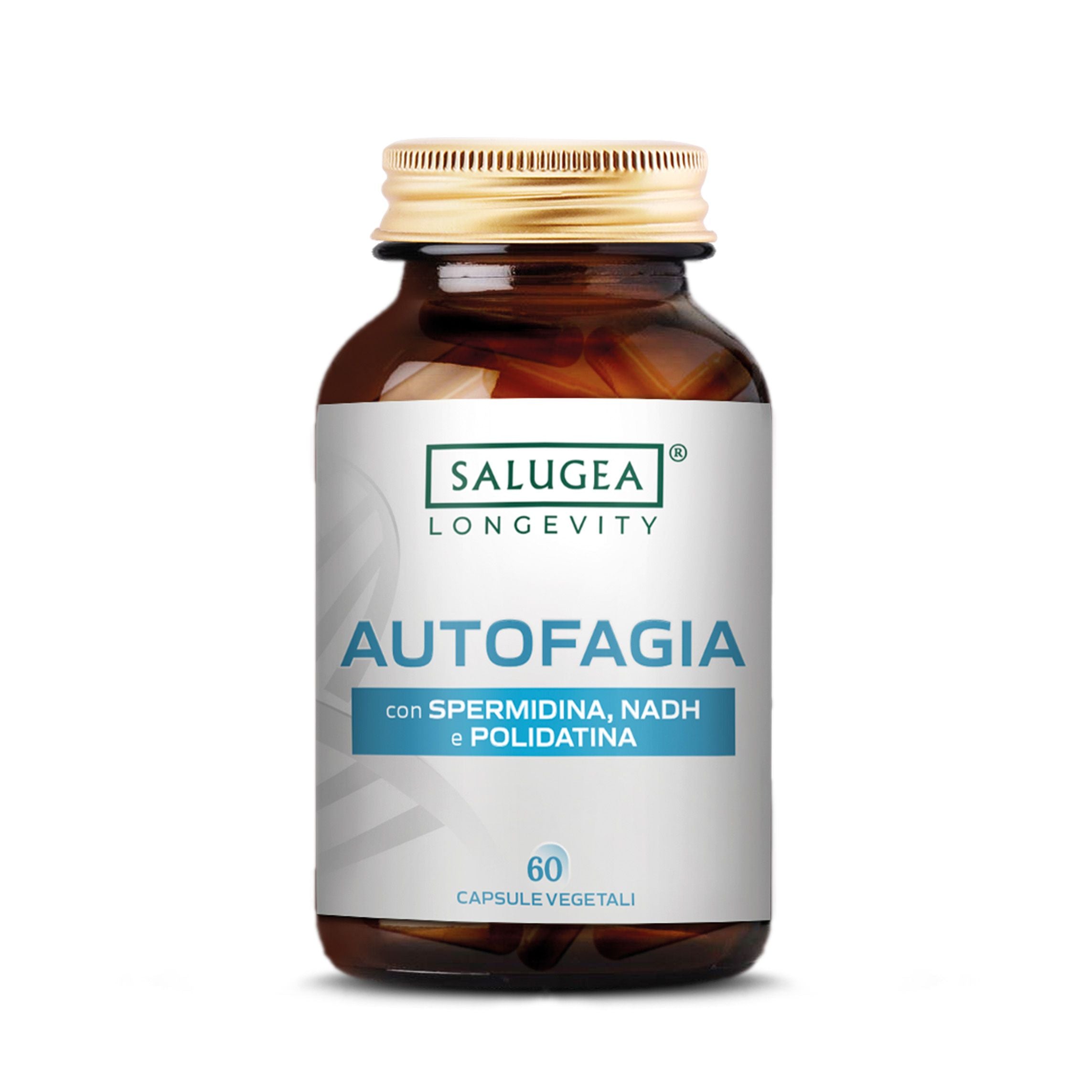
Autofagia Salugea was created for those who want to support physiological autophagic processes with a natural approach and an eye on the mechanisms of longevity. It is an increasingly common need, and one that Salugea chose to meet with its own quality and ethical standards.
In a single formula you’ll find natural Spermidine from wheat germ, microencapsulated NADH from bio-fermentation and highly bioavailable Polydatin. These are three active ingredients recognised for their role in the processes of cell renewal, mitochondrial energy and sirtuin support.
The decision to use only natural active ingredients, avoiding the synthetic forms that are widespread on the market (as is the case with many Spermidine products and with NR, or Nicotinamide Riboside), reflects Salugea’s focus on purity, quality and bioavailability.
The formula is completed by 5-HTP from Griffonia, Vitamin C from Rosehip, and Zinc and Selenium in organic form. These ingredients were all selected to work in synergy and support the body in its natural processes of balance and maintenance of cellular function.
Experimental Phytotherapy
Spermidine
- Hofer SJ, Simon AK, Bergmann M, Eisenberg T, Kroemer G, Madeo F.
Mechanisms of spermidine-induced autophagy and geroprotection. Nat Aging. 2022;2(12):1112-1129. doi:10.1038/s43587-022-00322-9.
This study, published in Nature Aging, analyses the mechanisms through which Spermidine supports the processes of autophagy and the phenomena associated with geroprotection.
The authors highlight how this molecule, ubiquitous and naturally present in many foods, is attracting growing scientific interest for its possible role in supporting the cellular processes linked to physiological ageing.
- Kiechl, S., Pechlaner, R., Willeit, P., et al. (2018). Higher spermidine intake is linked to lower mortality: a prospective population-based study. The American journal of clinical nutrition, 108(2), 371–380. https://doi.org/10.1093/ajcn/nqy102.
The Bruneck study, published in the American Journal of Clinical Nutrition, followed 829 adults for 20 years, also assessing their dietary intake of Spermidine through dedicated nutritional questionnaires. The analysis showed that those who consumed higher amounts of Spermidine in their diet had favourable indicators in terms of longevity.
The study therefore suggests a possible link between a Spermidine-rich diet and maintaining vitality over time, highlighting the growing interest in this natural compound in the field of wellbeing and cellular longevity.
- Wirth M, Benson G, Schwarz C, Köbe T, Grittner U, Schmitz D, Sigrist SJ, Bohlken J, Stekovic S, Madeo F, Flöel A. The effect of spermidine on memory performance in older adults at risk for dementia: A randomized controlled trial. Cortex. 2018 Dec;109:181-188. doi: 10.1016/j.cortex.2018.09.014. Epub 2018 Oct 4. PMID: 30388439.
In this clinical study of adults aged between 60 and 80 with cognitive deficits, three months of supplementation with a Spermidine-rich extract showed a positive effect on memory performance compared with placebo. The result suggests a possible role for Spermidine in supporting cognitive function.
NADH
- Walker MA, Tian R. NAD(H) in mitochondrial energy transduction: implications for health and disease. Curr Opin Physiol. 2018 Jun;3:101-109. doi: 10.1016/j.cophys.2018.03.011. Epub 2018 Apr 11. PMID: 32258851; PMCID: PMC7112453.
This paper describes how the NAD+/NADH ratio is fundamental to the work of the mitochondria, which produce ATP, the main form of energy for cells.
The authors explain that the amount of NAD+/NADH present in the cell regulates the rate at which mitochondria produce energy, by controlling various enzymes involved in metabolic processes.
- Srivastava S. Emerging therapeutic roles for NAD(+) metabolism in mitochondrial and age-related disorders. Clin Transl Med. 2016 Dec;5(1):25. doi: 10.1186/s40169-016-0104-7. Epub 2016 Jul 27. PMID: 27465020; PMCID: PMC4963347.
This study describes NADH as the main electron donor in the mitochondrial respiratory chain, an important step in producing ATP, the main form of cellular energy. The authors report that the NAD+/NADH ratio regulates many metabolic processes and that an imbalance in it can affect mitochondrial function and the balance of the cell. The study also suggests that NAD+ is used by sirtuins, which regulate various processes linked to metabolism and physiological cellular ageing.
- Campbell JM. Supplementation with NAD+and Its Precursors to Prevent Cognitive Decline across Disease Contexts. Nutrients. 2022 Aug 7;14(15):3231. doi: 10.3390/nu14153231. PMID: 35956406; PMCID: PMC9370773.
According to this review, raising NAD+ levels through its precursors is considered a promising approach to supporting cognitive abilities during ageing. The authors report encouraging results on the role of NAD+ in supporting processes linked to memory and brain wellbeing, while stressing the need for further clinical studies to better define its potential.
Polydatin
- Sun Z, Wang X, Xu Z. SIRT1 provides new pharmacological targets for polydatin through its role as a metabolic sensor. Biomed Pharmacother. 2021 Jul;139:111549. doi: 10.1016/j.biopha.2021.111549. Epub 2021 Apr 23. PMID: 33901876.
This review describes Polydatin as a natural compound able to interact with the sirtuin family, particularly SIRT1, which is considered an important regulator of cellular processes linked to metabolism, the stress response and physiological ageing. The authors also suggest that SIRT1 acts as a “metabolic sensor”, pointing to a possible role for Polydatin in supporting the mechanisms that help maintain cellular function over time.
- Hubbard BP, Sinclair DA. Small molecule SIRT1 activators for the treatment of aging and age-related diseases. Trends Pharmacol Sci. 2014 Mar;35(3):146-54. doi: 10.1016/j.tips.2013.12.004. Epub 2014 Jan 16. PMID: 24439680; PMCID: PMC3970218.
- Dai H, Sinclair DA, Ellis JL, Steegborn C. Sirtuin activators and inhibitors: Promises, achievements, and challenges. Pharmacol Ther. 2018 Aug;188:140-154. doi: 10.1016/j.pharmthera.2018.03.004. Epub 2018 Mar 22. PMID: 29577959; PMCID: PMC6342514.
These studies explore the role of Resveratrol as a natural sirtuin activator (STAC), with particular reference to SIRT1, a protein that regulates various cellular processes linked to metabolism, the stress response and the physiological phenomena of ageing. The authors highlight that the modulation of SIRT1 by Resveratrol is one of the most studied mechanisms for explaining its effects on cellular activity.
Griffonia
- Halford JC, Harrold JA, Lawton CL, Blundell JE. Serotonin (5-HT) drugs: effects on appetite expression and use for the treatment of obesity. Curr Drug Targets. 2005 Mar;6(2):201-13. doi: 10.2174/1389450053174550. PMID: 15777190.
This review highlights the role of serotonin (5-HT) in appetite control, particularly in the mechanisms of satiety during and after meals. The authors suggest that increasing the availability of 5-HT, as happens with 5-HTP, the natural precursor of serotonin, can help reduce appetite and calorie intake by modulating the receptors involved in the feeling of satiety.
Zinc
- Zheng W. The Zinc-dependent HDACs: Non-histone Substrates and Catalytic Deacylation Beyond Deacetylation. Mini Rev Med Chem. 2022;22(19):2478-2485. doi: 10.2174/1389557522666220330144151. PMID: 35362374.
This review describes how certain regulatory proteins in the cell, the zinc-dependent HDACs, specifically require Zinc in order to function properly.
The paper therefore highlights the role of Zinc as an essential cofactor for the proper functioning of various cellular pathways involved in maintaining cellular balance.
Selenium
- Giacconi R, Chiodi L, Boccoli G, Costarelli L, Piacenza F, Provinciali M, Malavolta M. Reduced levels of plasma selenium are associated with increased inflammation and cardiovascular disease in an Italian elderly population. Exp Gerontol. 2021 Mar;145:111219. doi: 10.1016/j.exger.2020.111219. Epub 2020 Dec 26. PMID: 33373712.
In this study, Selenium deficiency was associated with higher levels of inflammatory markers and, above all, with reduced expression of several sirtuins (SIRT1, SIRT5, SIRT6 and SIRT7) in blood cells. Since sirtuins are involved in the processes of metabolic balance, stress response and maintenance of cellular function, the researchers suggest that an adequate intake of Selenium may help support their normal functioning.
Autofagia Salugea is a food supplement: read the warnings on the label. Supplements should not be used as a substitute for a varied and balanced diet and a healthy lifestyle. These texts are for information purposes only; they should not be taken as guidance for the diagnosis or treatment of medical conditions and do not replace your doctor’s advice.
Bibliography
[1] Clardy J, Walsh C. Lessons from natural molecules. Nature. 2004 Dec 16;432(7019):829-37. doi: 10.1038/nature03194. PMID: 15602548.
[2] Hofer SJ, Simon AK, Bergmann M, Eisenberg T, Kroemer G, Madeo F. Mechanisms of spermidine-induced autophagy and geroprotection. Nat Aging. 2022 Dec;2(12):1112-1129. doi: 10.1038/s43587-022-00322-9. Epub 2022 Dec 22. PMID: 37118547.
[3] Sun Z, Wang X, Xu Z. SIRT1 provides new pharmacological targets for polydatin through its role as a metabolic sensor. Biomed Pharmacother. 2021 Jul;139:111549. doi: 10.1016/j.biopha.2021.111549. Epub 2021 Apr 23. PMID: 33901876
[4] Madsen, A. S. et al. Investigating the sensitivity of NAD+-dependent sirtuin deacylation activities to NADH. J. Biol. Chem. 291, 7128–7141
[5] Ni YQ, Liu YS. New Insights into the Roles and Mechanisms of Spermidine in Aging and Age-Related Diseases. Aging Dis. 2021 Dec 1;12(8):1948-1963. doi: 10.14336/AD.2021.0603. PMID: 34881079; PMCID: PMC8612618.
[6] Walker MA, Tian R. NAD(H) in mitochondrial energy transduction: implications for health and disease. Curr Opin Physiol. 2018 Jun;3:101-109. doi: 10.1016/j.cophys.2018.03.011. Epub 2018 Apr 11. PMID: 32258851; PMCID: PMC7112453.
[7] Heisler LK, Jobst EE, Sutton GM, Zhou L, Borok E, Thornton-Jones Z, Liu HY, Zigman JM, Balthasar N, Kishi T, Lee CE, Aschkenasi CJ, Zhang CY, Yu J, Boss O, Mountjoy KG, Clifton PG, Lowell BB, Friedman JM, Horvath T, Butler AA, Elmquist JK, Cowley MA. Serotonin reciprocally regulates melanocortin neurons to modulate food intake. Neuron. 2006 Jul 20;51(2):239-49. doi: 10.1016/j.neuron.2006.06.004. PMID: 16846858.
[8] Halford JC, Harrold JA, Lawton CL, Blundell JE. Serotonin (5-HT) drugs: effects on appetite expression and use for the treatment of obesity. Curr Drug Targets. 2005 Mar;6(2):201-13. doi: 10.2174/1389450053174550. PMID: 15777190.
[9] Bagherniya M, Butler AE, Barreto GE, Sahebkar A. The effect of fasting or calorie restriction on autophagy induction: A review of the literature. Ageing Res Rev. 2018 Nov;47:183-197. doi: 10.1016/j.arr.2018.08.004. Epub 2018 Aug 30. PMID: 30172870.
[10] Hansen, M., Rubinsztein, D.C. & Walker, D.W. Autophagy as a promoter of longevity: insights from model organisms. Nat Rev Mol Cell Biol 19, 579–593 (2018). https://doi.org/10.1038/s41580-018-0033-y
[11] Madeo F, Carmona-Gutierrez D, Kepp O, Kroemer G. Spermidine delays aging in humans. Aging (Albany NY). 2018 Aug 6;10(8):2209-2211. doi: 10.18632/aging.101517. PMID: 30082504; PMCID: PMC6128428.
[12] Hofer, S.J., Daskalaki, I., Bergmann, M. et al. Spermidine is essential for fasting-mediated autophagy and longevity. Nat Cell Biol 26, 1571–1584 (2024). https://doi.org/10.1038/s41556-024-01468-x
[13] Kiechl, S., Pechlaner, R., Willeit, P., et al. (2018). Higher spermidine intake is linked to lower mortality: a prospective population-based study. The American journal of clinical nutrition, 108(2), 371–380. https://doi.org/10.1093/ajcn/nqy102
[14] Srivastava S. Emerging therapeutic roles for NAD(+) metabolism in mitochondrial and age-related disorders. Clin Transl Med. 2016 Dec;5(1):25. doi: 10.1186/s40169-016-0104-7. Epub 2016 Jul 27. PMID: 27465020; PMCID: PMC4963347.
[15] Vis Vitalis - "Stability of PANMOL®️ NADH in simulated gastric fluid conditions" - https://www.harnisch-digital.de/viitalstoffe-1-2024/68698255/48
[16] Dai H, Sinclair DA, Ellis JL, Steegborn C. Sirtuin activators and inhibitors: Promises, achievements, and challenges. Pharmacol Ther. 2018 Aug;188:140-154. doi: 10.1016/j.pharmthera.2018.03.004. Epub 2018 Mar 22. PMID: 29577959; PMCID: PMC6342514.
[17] Hubbard BP, Sinclair DA. Small molecule SIRT1 activators for the treatment of aging and age-related diseases. Trends Pharmacol Sci. 2014 Mar;35(3):146-54. doi: 10.1016/j.tips.2013.12.004. Epub 2014 Jan 16. PMID: 24439680; PMCID: PMC3970218
[18] Liguori I, Russo G, Curcio F, Bulli G, Aran L, Della-Morte D, Gargiulo G, Testa G, Cacciatore F, Bonaduce D, Abete P. Oxidative stress, aging, and diseases. Clin Interv Aging. 2018 Apr 26;13:757-772. doi: 10.2147/CIA.S158513. PMID: 29731617; PMCID: PMC5927356.
[19] Giacconi R, Chiodi L, Boccoli G, Costarelli L, Piacenza F, Provinciali M, Malavolta M. Reduced levels of plasma selenium are associated with increased inflammation and cardiovascular disease in an Italian elderly population. Exp Gerontol. 2021 Mar;145:111219. doi: 10.1016/j.exger.2020.111219. Epub 2020 Dec 26. PMID: 33373712
[20] Shengyu C, Yinhua L, Yuanhong L, Jinbo Z, Can F, Hao X, Changjiang Z. Selenium alleviates heart remodeling through Sirt1/AKT/GSK-3β pathway. Int Immunopharmacol. 2022 Oct;111:109158. doi: 10.1016/j.intimp.2022.109158. Epub 2022 Aug 18. PMID: 35987147.
Our texts are for information purposes only; they are not to be understood as an indication for the diagnosis and treatment of medical conditions and are in no way intended to replace the advice of a doctor.