Although they are less famous than the common “high cholesterol”, “bloated tummy”, “stress” ... venous problems (in particular chronic venous insufficiency and chronic venous disease) are extremely widespread.
To get a detailed idea of just how commonplace these complaints are, consider that between 25 and 60% of the world's population, depending on the geographical area, has at least one venous problem (varicose veins, visible or fragile capillaries, haemorrhoids, swollen and aching legs ...) 4.
In particular, it is women who suffer from them more frequently than men (with a ratio of 3:1) 5.
It is estimated that 40% of women from the age of 50 onwards suffer from some form of chronic venous disease 6.
The complexity of this disorder, which is often underestimated, presents clinically with a range of objective findings, from the absence of symptoms to visible and fragile capillaries (telangiectasias), itching, pain, oedema, local inflammation, phlebitis and thrombosis, through to the most extreme pictures.
Among the most common factors leading to an alteration of the venous system are:
- family history: in 85% of cases, if we have venous complaints it is because one of our parents/grandparents had them too;
- lifestyle: spending many hours sitting or standing, smoking, the consumption of sugars and refined foods, and being overweight are the most frequent situations that throw the door wide open to the onset of varicose veins, fragile capillaries, inflamed haemorrhoids, etc.
Venous complaints develop slowly and silently, and with time they become more and more evident. Their effects are felt in everyday life with aching legs, networks of visible veins and capillaries, hands and feet that are always cold and swollen, the need to keep moving your legs, pain on touch, intolerance of the summer heat, haemorrhoidal discomfort, ...
These phenomena can occur both at a deep level (large-calibre veins) and at a superficial level (capillaries), for a whole series of different reasons.
The important thing to understand is that once the inflammatory phase has started at one point in the venous system, it will proceed, more or less quickly but inexorably, towards other areas, progressively further away.
That is why it is important to act at once, whatever the case! (it is never too late!). On this point, seek the advice of your doctor.
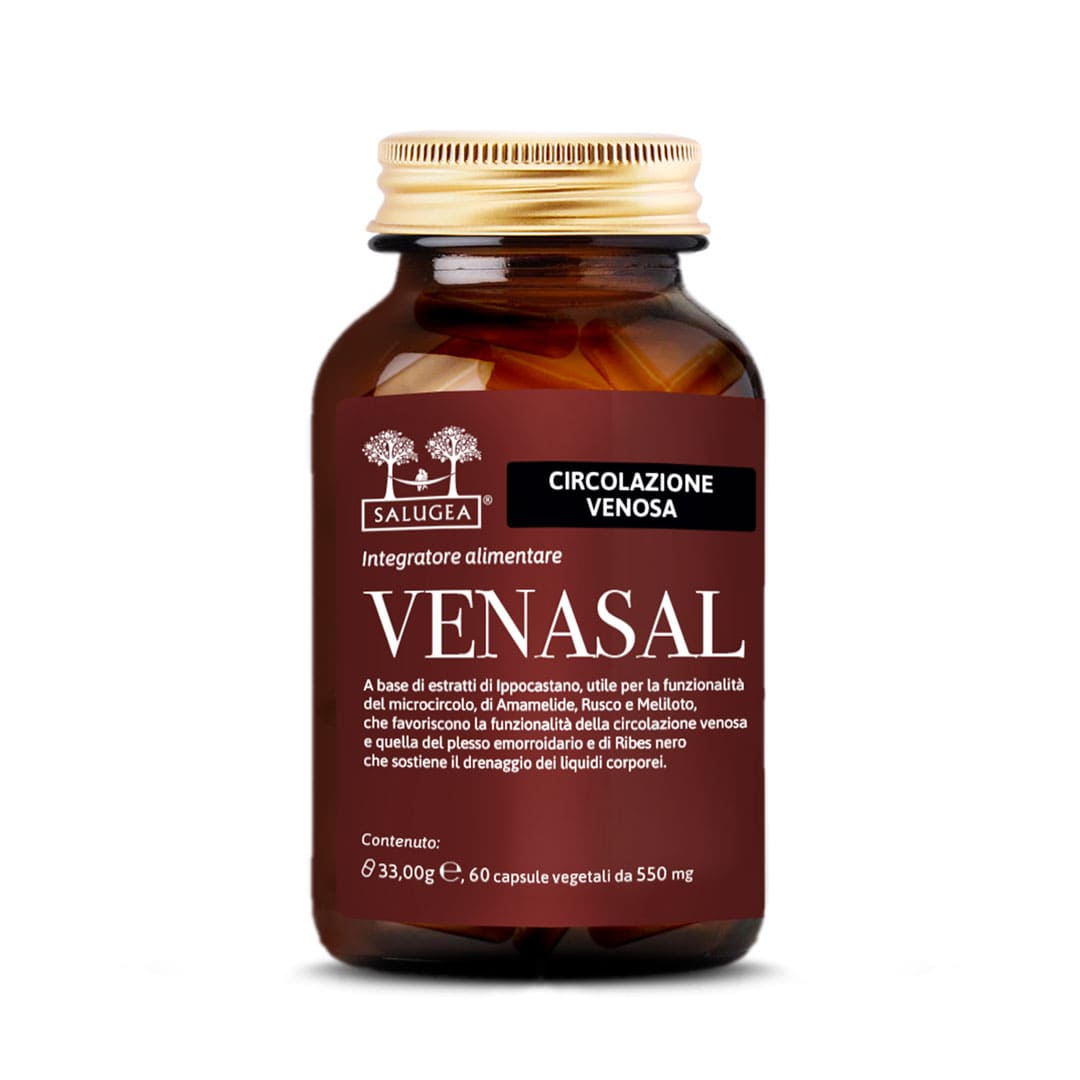
Venasal is the Salugea supplement created to maintain and support the natural structure of the veins and, in general, of the circulation.
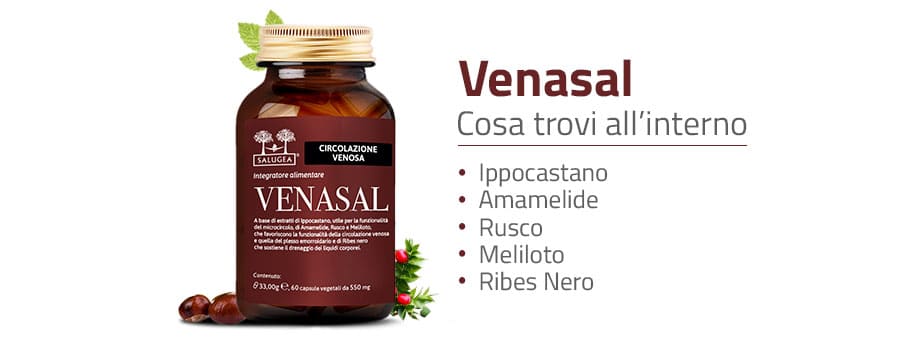
Based on Horse Chestnut, Witch Hazel, Butcher's Broom, Sweet Clover and Blackcurrant, it allows you to support the physiological structure of the veins starting from the endothelium.
And if your veins and capillaries are “in shape”, you feel better too, because you will have lighter legs, ankles and feet free of swelling, hands and feet that are finally warm (much to the relief of your partner, who will at last no longer find icicles under the covers!) and much more!
Experimental Phytotherapy
Horse Chestnut
- Gallelli L. Escin: a review of its anti-edematous, anti-inflammatory, and venotonic properties. Drug Des Devel Ther. 2019 Sep 27;13:3425-3437. doi: 10.2147/DDDT.S207720. PMID: 31631970; PMCID: PMC6776292.
This study analyses the pharmacological and clinical data, both historical and recent, on the anti-oedematous, anti-inflammatory and venotonic properties of escin, the active ingredient of Horse Chestnut.
The anti-inflammatory and anti-oedematous effects of escin have been studied for many years in preclinical models.
More recent data confirm the anti-inflammatory properties of escin in reducing the vascular permeability of inflamed tissues, thereby inhibiting the formation of oedema.
The venotonic effects of escin have been demonstrated mainly through in vitro studies on isolated human saphenous veins.
Escin, as an oral formulation or topical gel, reduces oedema and increases venous tone, producing measurable improvements in venous haemodynamics, both in patients with contusion injuries and in those with chronic venous insufficiency.
Witch Hazel
- MacKay D. Hemorrhoids and varicose veins: a review of treatment options. Altern Med Rev. 2001 Apr;6(2):126-40. PMID: 11302778..
Witch Hazel is a well-known shrub native to the deciduous forest areas of North America.
Its extract is rich in tannins, flavonoids and volatile oils.
This plant is traditionally used for its astringent, anti-inflammatory and haemostatic properties.
In folk medicine, Witch Hazel extract has been used for venous problems, such as haemorrhoids and varicose veins.
Several studies have investigated the mechanism responsible for the astringent action and the antiphlogistic properties of witch hazel.
It has been seen that, in vivo, the extract inhibits alpha-glucosidase and leukocyte elastase, enzymes that contribute to the degradation of connective tissue. Vascular integrity is compromised by the increased activity of these enzymes. The antiphlogistic activity is probably sustained by the proanthocyanidins. Together, these actions can prove useful for protecting venous vascular function.
- Habtemariam S. Hamamelitannin from Hamamelis virginiana inhibits the tumour necrosis factor-alpha (TNF)-induced endothelial cell death in vitro. Toxicon. 2002 Jan;40(1):83-8. doi: 10.1016/s0041-0101(01)00195-7. PMID: 11602283.
This study assessed the inhibitory activity on tumour necrosis factor alpha (TNF) exerted by the hamamelitannin extracted from Witch Hazel.
In particular, its impact on TNF-mediated endothelial cell death and on adhesion to monocytes was assessed.
Hamamelitannin inhibited TNF-mediated endothelial cell death by reducing the fragmentation of their DNA.
Endothelial cells make up the endothelium, which is the tissue lining the inside of blood vessels. By protecting this structure we support the physiological function of the vascular system.
Sweet Clover
- Michelini S, Fiorentino A, Cardone M. Melilotus, Rutin and Bromelain in primary and secondary lymphedema. 2019;52(4):177-186. PMID: 32171184.
In this study, natural compounds obtained from Sweet Clover and compounds such as Rutin and Bromelain were administered to patients with primary and secondary lymphoedema.
The results showed that the combination of these compounds can be a valid aid in the clinical control of both primary and secondary lymphoedema and of inflammatory phenomena linked to chronic venous stasis.
- Pleşca-Manea L, Pârvu AE, Pârvu M, Taămaş M, Buia R, Puia M. Effects of Melilotus officinalis on acute inflammation. Phytother Res. 2002 Jun;16(4):316-9. doi: 10.1002/ptr.875. PMID: 12112285.
This study assessed the effects of an extract of Melilotus officinalis L., containing 0.25% coumarin, on acute inflammation induced in an animal model.
The results showed that Sweet Clover had anti-inflammatory effects, since it reduced the activation of circulating phagocytes and lowered the production of citrulline. These properties are similar to those of hydrocortisone and coumarin.
It is therefore possible to use sweet clover in products that aim to support the circulation, especially in conditions of inflammation.
Butcher's Broom
- Vanscheidt W, Jost V, Wolna P, Lücker PW, Müller A, Theurer C, Patz B, Grützner KI. Efficacy and safety of a Butcher's broom preparation (Ruscus aculeatus L. extract) compared to placebo in patients suffering from chronic venous insufficiency. 2002;52(4):243-50. doi: 10.1055/s-0031-1299887. PMID: 12040966.
Extracts of the rhizome of butcher's broom (Ruscus aculeatus) have been widely used in the oral treatment of oedema of the lower legs in patients with chronic venous insufficiency.
The aim of this multicentre study was to confirm the efficacy and safety of a butcher's broom extract according to the most recent scientific standards.
166 women suffering from chronic venous insufficiency of varying degrees were included.
The main parameters taken into consideration were leg volume, lower leg volume and ankle volume.
Treatment with Butcher's Broom showed significant differences in the measurements and an improvement in symptoms (heavy legs, feeling of tightness, tingling, …).
The overall assessment of efficacy was significantly better for the butcher's broom extract than for the placebo.
These assessments make Butcher's Broom extract a useful ingredient in supporting the cardiovascular system in the presence of chronic venous insufficiency.
Blackcurrant
- Rashid S, Idris-Khodja N, Auger C, Kevers C, Pincemail J, Alhosin M, Boehm N, Oswald-Mammosser M, Schini-Kerth VB. Polyphenol-Rich Blackcurrant Juice Prevents Endothelial Dysfunction in the Mesenteric Artery of Cirrhotic Rats with Portal Hypertension: Role of Oxidative Stress and the Angiotensin System. J Med Food. 2018 Apr;21(4):390-399. doi: 10.1089/jmf.2017.0078. Epub 2018 Mar 23. PMID: 29569976.
This study assessed the possibility that the intake of polyphenol-rich blackcurrant juice, a rich natural source of antioxidants, prevents endothelial dysfunction in a model of cirrhosis induced by chronic bile duct ligation (CBDL) in the rat.
Overall, the results indicate that the regular ingestion of polyphenol-rich blackcurrant juice prevents CBDL-induced endothelial dysfunction in the mesenteric artery, most likely by normalising the level of vascular oxidative stress and the angiotensin system.
N.B. Our texts are for information purposes only; they are not to be understood as an indication for the diagnosis and treatment of medical conditions and are in no way intended to replace the advice of a doctor.
Bibliography
1 Gallelli L. Escin: a review of its anti-edematous, anti-inflammatory, and venotonic properties. Drug Des Devel Ther. 2019 Sep 27;13:3425-3437. doi: 10.2147/DDDT.S207720. PMID: 31631970; PMCID: PMC6776292.
2 MacKay D. Hemorrhoids and varicose veins: a review of treatment options. Altern Med Rev. 2001 Apr;6(2):126-40. PMID: 11302778.
3 de Almeida Cyrino FZG, Balthazar DS, Sicuro FL, Bouskela E. Effects of venotonic drugs on the microcirculation: Comparison between Ruscus extract and micronized diosmine1. Clin Hemorheol Microcirc. 2018;68(4):371-382. doi: 10.3233/CH-170281. PMID: 29036797.
4 Rabe E, Guex JJ, Puskas A, Scuderi A, Fernandez Quesada F; VCP Coordinators. Epidemiology of chronic venous disorders in geographically diverse populations: results from the Vein Consult Program. Int Angiol. 2012 Apr;31(2):105-15. PMID: 22466974.
5 Evans CJ, Fowkes FG, Ruckley CV, Lee AJ. Prevalence of varicose veins and chronic venous insufficiency in men and women in the general population: Edinburgh Vein Study. J Epidemiol Community Health. 1999 Mar;53(3):149-53. doi: 10.1136/jech.53.3.149. PMID: 10396491; PMCID: PMC1756838.
6 Humanitas Medical Care - Vene varicose: non è solo un problema estetico [Varicose veins: not just an aesthetic problem]. - Dr. Marcello Ghezzi
Our texts are for information purposes only; they are not to be understood as an indication for the diagnosis and treatment of medical conditions and are in no way intended to replace the advice of a doctor.