What are probiotics? And the microbiota?
We hear more and more about probiotics and the microbiota. But what exactly are they?
Probiotics are beneficial microorganisms useful for the functioning of our body, and they belong to many different families.
The probiotics naturally present in our gut, mostly bacteria and yeasts, form the microbiota, that is, our gut bacterial flora: an ecosystem which, when in balance, provides the best support for gut function and protects us from attack by external agents that can cause alterations and, in turn, various complaints.
Now, when the microbiota is in balance, we speak of eubiosis. When, instead, it is in a condition of imbalance, we speak of dysbiosis.
What can cause an imbalance of the microbiota?
There are many factors that can generate dysbiosis, that is, an imbalance of the gut microbiota — for example a poor diet, stress and antibiotic treatments.
The most common consequences of dysbiosis?
- Flatulence (abdominal gas)
- Abdominal bloating
- Diarrhoea
- Constipation
- Bowel disturbances (with alternating diarrhoea and constipation)
- Digestive difficulties
Nothing good, in short...
What can you do to have a balanced microbiota?
First of all, you need to act on lifestyle factors — on diet, on stress and, in general, on all those habits that can affect our wellbeing. And then take probiotics, paying attention to the type of product you choose.
What does a good probiotic for the gut look like? First of all, it must offer you a wide variety of probiotics, coming from several families, genera, species and strains.
This is because a huge number of different species of microorganisms live together in our gut: offering an altered gut a single type of probiotic would therefore be, to say the least, a “limited” approach.
Of course, it might have a beneficial effect in the moment, but if you want to restore your gut flora properly — and it is a genuine ecosystem — you need to help it with a certain number of different probiotics, so that the colonisation – which in this case is a beneficial colonisation – is as diversified as possible.
If you think about it, it is a concept similar to that of biodiversity: if an area has high biodiversity, this is considered a sign of the healthiness of the area itself; when, instead, the plant and animal species present in an area are reduced, in terms of spread and variety, that area will be considered degraded.
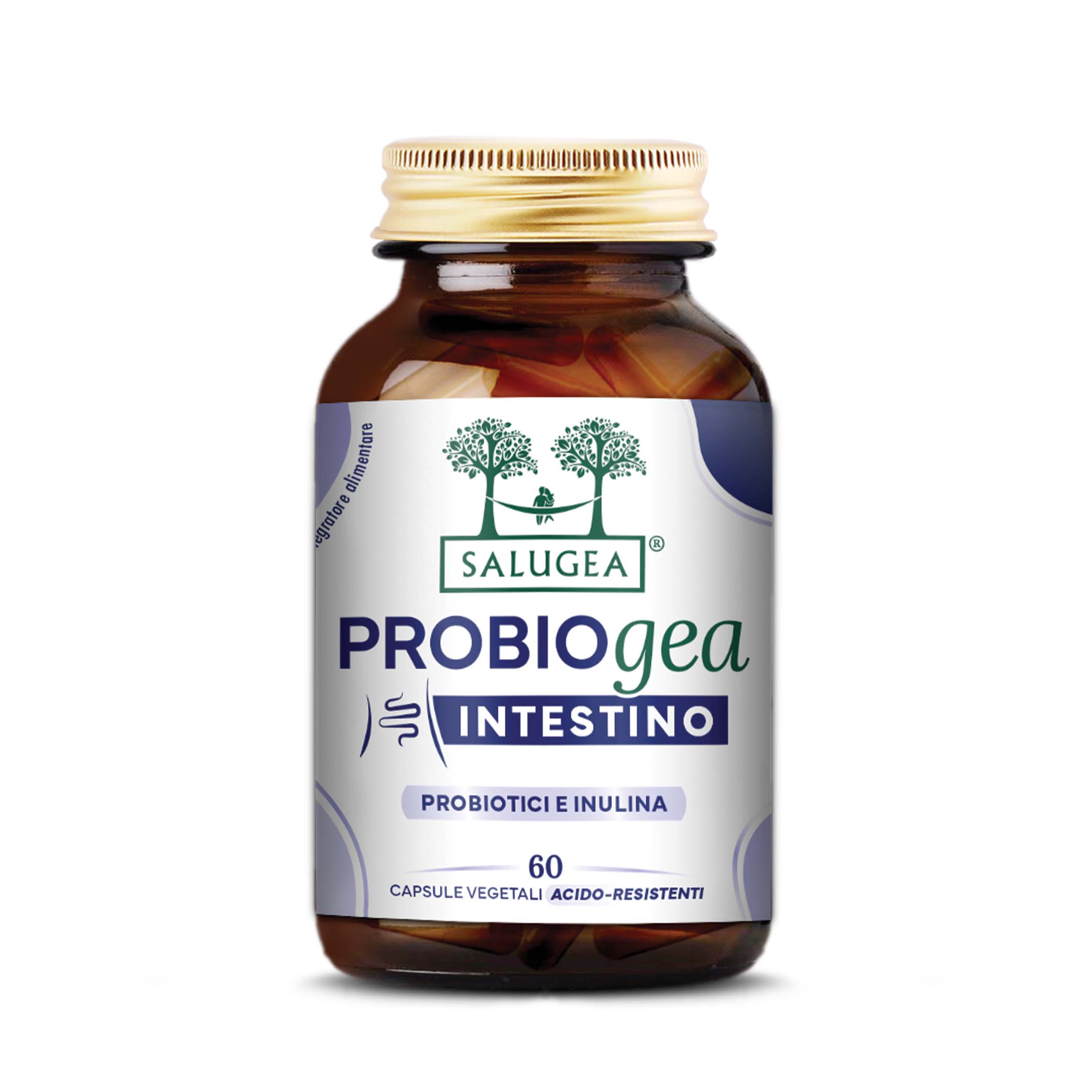
This is why in ProbioGea Intestino you will find a rich complex of probiotics – lactobacilli, bifidobacteria, bacilli, yeasts – coming from different families, genera, species and strains, all of them naturally present in a healthy gut.
Let’s now look at some studies conducted on the probiotics we have selected.
Scientific Bibliography
SynbÆctive® SmilinGut
Presti I, D’Orazio G, Labra M, et al. Evaluation of the probiotic properties of new Lactobacillus and Bifidobacterium strains and their in vitro effect. Appl Microbiol Biotechnol. 2015 Jul;99(13):5613-26. doi: 10.1007/s00253-015-6482-8. Epub 2015 Mar 7. PMID: 25744647.
In this test against Escherichia coli, one of the strains most frequently responsible for serious food poisoning and gastrointestinal infections (diarrhoea, nausea, abdominal cramps, exhaustion and fever), it was seen that the SynbÆctive® SmilinGut probiotic complex, compared with the individual strains, significantly cuts down the concentration of Escherichia coli. In essence, the probiotic complex had an antimicrobial effect that prevented the pathogen from replicating, halting its colonisation, and, what is more, that effect remained stable over time. This shows how important it is, for the protection of the gut over time, to act synergistically with a complex that offers several probiotics.
D’Orazio G, Di Gennaro P, Boccarusso M, et al. Microencapsulation of new probiotic formulations for gastrointestinal delivery: in vitro study to assess viability and biological properties. Appl Microbiol Biotechnol. 2015 Nov;99(22):9779-89. doi: 10.1007/s00253-015-6853-1. Epub 2015 Aug 4. PMID: 26239070.
This in vitro study on human intestinal cells showed that the SynbÆctive® SmilinGut probiotic complex is able to act positively on various aspects of the physiology of the intestinal mucosa, from protection against inflammatory stress to protection against oxidative stress. This is because it reduces various pro-inflammatory mediators (the ones that amplify inflammation) and increases anti-inflammatory mediators, with better results (also in terms of maintaining the action over time) than the individual strains. We can therefore state, once again, the importance of helping the gut with several types of probiotics at the same time.
Mezzasalma V, Manfrini E, Ferri E, et al. A Randomized, Double-Blind, Placebo-Controlled Trial: The Efficacy of Multispecies Probiotic Supplementation in Alleviating Symptoms of Irritable Bowel Syndrome Associated with Constipation. Biomed Res Int. 2016;2016:4740907. doi: 10.1155/2016/4740907. Epub 2016 Aug 9. Erratum in: Biomed Res Int. 2019 Apr 9;2019:9042956. PMID: 27595104; PMCID: PMC4993960.
This is a clinical study on 100 subjects of both sexes, aged between 18 and 65, suffering from irritable bowel syndrome with constipation. The subjects were divided into two groups and for 60 days received, respectively, the probiotic complex and the placebo, with a further 30 days of follow-up after the treatment was stopped. What was seen? With the placebo, the level of “good” bacteria stayed close to 0 or decreased, while with the SynbÆctive® SmilinGut probiotic complex the “good” bacteria increased in a markedly significant way. Moreover, in the test group there were substantial improvements in constipation, bloating, abdominal pain, flatulence and abdominal cramps, and these results were maintained over time. This means that the complex positively modifies the probiotic situation present in the gut and that, besides ensuring a result is achieved, it encourages its maintenance over time.
Bifidobacterium longum
Bonfrate L, Di Palo DM, Celano G, et al. Effects of Bifidobacterium longum BB536 and Lactobacillus rhamnosus HN001 in IBS patients. Eur J Clin Invest. 2020 Mar;50(3):e13201. doi: 10.1111/eci.13201. Epub 2020 Feb 12. PMID: 31960952.
In this clinical work, 25 patients with irritable bowel syndrome received a combined treatment of Bifidobacterium longum and Lactobacillus rhamnosus (the latter present in SynbÆctive® SmilinGut) or a placebo. Results of the treatment with B. longum and L. rhamnosus: compared with the placebo, there were considerable reductions in abdominal pain (-50% vs -3.5%), abdominal bloating (-36% vs -7%) and the intensity of overall symptoms (-30% vs -0.4%). In addition, both in patients with diarrhoea and in patients with constipation, there was an improvement in stool formation. Finally, the test group also showed a clear improvement in sucralose recovery, a test of colon permeability that indicates whether and to what extent the colon is “leaky”; an increase was detected in short-chain fatty acids, which are a sign of a restoration of metabolic conditions in the gut flora. So a treatment with B. longum and L. rhamnosus manages to improve the symptoms and severity of irritable bowel syndrome, both in its diarrhoea form and in its constipation form.
Colecchia A, Vestito A, La Rocca A, et al.; Symbiotic Study Group. Effect of a symbiotic preparation on the clinical manifestations of irritable bowel syndrome, constipation-variant. Results of an open, uncontrolled multicenter study. Minerva Gastroenterol Dietol. 2006 Dec;52(4):349-58. PMID: 17108864.
Here we have a clinical study on over 600 patients with irritable bowel syndrome characterised by constipation. The patients were enrolled at 43 different centres (so with a very varied case mix) and, divided into two groups, received either a placebo or a treatment with Bifidobacterium longum and a prebiotic. Results: with the treatment, the number of patients without abdominal bloating increased 10-fold and the proportion of patients without abdominal pain went from 8.4% to 44.1%. Among patients with moderate to severe symptoms, the frequency of symptoms fell 6-fold for bloating and from 38.8% to 4.1% for abdominal pain. Furthermore, the frequency of bowel movements increased significantly after the treatment. So the administration of B. longum can be useful for patients with irritable bowel syndrome with constipation.
Skrzydło-Radomańska B, Prozorow-Król B, Cichoż-Lach H, et al. The Effectiveness of Synbiotic Preparation Containing Lactobacillus and Bifidobacterium Probiotic Strains and Short Chain Fructooligosaccharides in Patients with Diarrhea Predominant Irritable Bowel Syndrome-A Randomized Double-Blind, Placebo-Controlled Study. Nutrients. 2020 Jul 5;12(7):1999. doi: 10.3390/nu12071999. PMID: 32635661; PMCID: PMC7400954.
In this clinical study on 68 patients with irritable bowel syndrome characterised by diarrhoea (IBS-D), either a placebo or a treatment with lactobacilli and bifidobacteria was administered for 8 weeks. Compared with the placebo, the treatment significantly improved all the parameters of IBS-D, bringing an improvement in the scores for flatulence and bowel habits (that is, the frequency of bowel movements was normalised). Patients reported a significant improvement in the sensation of incomplete bowel movements, flatulence, pain, stool pressure and diarrhoeal stools. So lactobacilli and bifidobacteria are useful also in cases of irritable bowel syndrome characterised by diarrhoea.
Bacillus coagulans
Majeed M, Nagabhushanam K, Paulose S, Arumugam S, Mundkur L. The effects of Bacillus coagulans MTCC 5856 on functional gas and bloating in adults: A randomized, double-blind, placebo-controlled study. Medicine (Baltimore). 2023 Mar 3;102(9):e33109. doi: 10.1097/MD.0000000000033109. PMID: 36862903; PMCID: PMC9982755.
This clinical study on 68 adults with gas and abdominal bloating tested Bacillus coagulans against a placebo for 4 weeks. The results highlighted significant changes in clinical scores, changes corresponding to an improvement in symptoms, suggesting that B. coagulans can be a valuable ally in reducing gastrointestinal symptoms in adults with gas and abdominal bloating.
Gupta AK, Maity C. Efficacy and safety of Bacillus coagulans LBSC in irritable bowel syndrome: A prospective, interventional, randomized, double-blind, placebo-controlled clinical study [CONSORT Compliant]. Medicine (Baltimore). 2021 Jan 22;100(3):e23641. doi: 10.1097/MD.0000000000023641. PMID: 33545934; PMCID: PMC7837859.
In this further work on patients with irritable bowel syndrome (IBS), it was seen that Bacillus coagulans brought a significant improvement over the placebo across a wide range of symptoms: bloating/cramps, abdominal pain, diarrhoea, constipation, stomach rumbling, nausea, vomiting, headache and anxiety. So B. coagulans proved effective in relieving the pathophysiological symptoms of IBS and, in turn, in improving the overall quality of life of people affected by the syndrome.
Saccharomyces boulardii
Fidan I, Kalkanci A, Yesilyurt E, et al. Effects of Saccharomyces boulardii on cytokine secretion from intraepithelial lymphocytes infected by Escherichia coli and Candida albicans. Mycoses. 2009 Jan;52(1):29-34. doi: 10.1111/j.1439-0507.2008.01545.x. Epub 2008 Jun 21. PMID: 18627477.
In this in vitro study, the influence of Saccharomyces boulardii on the secretion of cytokines by intraepithelial lymphocytes infected with Escherichia coli and Candida albicans was investigated. The results highlighted that S. boulardii can have protective effects against these pathogens, reducing the pro-inflammatory response.
Carstensen JW, Chehri M, Schønning K, Rasmussen SC, Anhøj J, Godtfredsen NS, Andersen CØ, Petersen AM. Use of prophylactic Saccharomyces boulardii to prevent Clostridium difficile infection in hospitalized patients: a controlled prospective intervention study. Eur J Clin Microbiol Infect Dis. 2018 Aug;37(8):1431-1439. doi: 10.1007/s10096-018-3267-x. Epub 2018 May 3. PMID: 29725956.
Clostridium difficile is a pathogen that often develops following the use of antibiotics. This study evaluated the effectiveness of Saccharomyces boulardii in preventing C. difficile infections in hospitalised patients treated with antibiotics, and it highlighted that preventive treatment with S. boulardii reduces the likelihood of contracting this infection in the hospital setting by over 50%.
Kabbani TA, Pallav K, Dowd SE, et al. Prospective randomized controlled study on the effects of Saccharomyces boulardii CNCM I-745 and amoxicillin-clavulanate or the combination on the gut microbiota of healthy volunteers. Gut Microbes. 2017 Jan 2;8(1):17-32. doi: 10.1080/19490976.2016.1267890. Epub 2016 Dec 14. PMID: 27973989; PMCID: PMC5341914.
This study gave 49 healthy subjects, divided into 4 groups, S. boulardii for 14 days, an antibiotic (Amoxicillin-Clavulanate) for 7 days, antibiotic + S. boulardii, or no treatment. The subjects treated with S. boulardii + antibiotic had fewer adverse events and tolerated the antibiotic better than those treated with the antibiotic alone. In the group that received only the antibiotic, there were significant deteriorations of the microbiota, whose normal conditions had still not been fully restored a good 2 weeks after the antibiotic therapy; the addition of S. boulardii to the antibiotic, on the other hand, led to less pronounced changes in the microbiota and to a reduction in antibiotic-associated diarrhoea. So treatment with the addition of S. boulardii can mitigate some antibiotic-induced changes in the microbiota and can also reduce the diarrhoea associated with antibiotic therapy.
Inulin from Chicory
Qin YQ, Wang LY, Yang XY, et al. Inulin: properties and health benefits. Food Funct. 2023 Apr 3;14(7):2948-2968. doi: 10.1039/d2fo01096h. PMID: 36876591.
This review of studies focuses on the function of Inulin and on its health benefits, including its recognised prebiotic activity and, in turn, the stimulus it gives to the growth of beneficial bacteria and the resulting contribution to the balance of the gut microbiota.
Hughes RL, Alvarado DA, Swanson KS, Holscher HD. The Prebiotic Potential of Inulin-Type Fructans: A Systematic Review. Adv Nutr. 2022 Mar;13(2):492-529. doi: 10.1093/advances/nmab119. Epub 2023 Feb 10. PMID: 34555168; PMCID: PMC8970830.
This review of studies confirms the prebiotic effect of Inulin on the gut microbiota (through the promotion of the levels of bifidobacteria and lactobacilli) and its beneficial action on the function of the intestinal barrier.
Our texts are for information purposes only; they are not to be understood as an indication for the diagnosis and treatment of medical conditions and are in no way intended to replace the advice of a doctor.