An average of 12.000 liters of air goes in and out of our respiratory tract every day. The air we breathe-in contains various kinds of micro-organisms, including harmful bacteria and viruses.
Normally, our airways are well protected. Yet, due to some factors - like sudden temperature changes, pollution, unhealthy habits (like smoking ) or a general lack of energy - the risks of our airways being colonized by pathogens increases and so does the risk of acute respiratory infections (ARI) such as flu and cold.
Acute Respiratory Infections: what are the causes?
Statistic data1 confirm that:
- bacteria are the cause of ARI only in 10% of the cases,
- while viruses are responsible in 70% of the cases.
Specifically,
- rhinovirus, adenovirus and coronavirus are responsible for colds, with symptoms that go away in 4 to 10 days, usually without fever,
- influenza and parainfluenza viruses cause fever with a body temperature even over 39°C, and recovery takes 1 to 2 weeks.
Who is most vulnerable to flu (influenza) and why.
The incidence of influenza and parainfluenza decreases with age. In fact, small children are by far the most subject to flu.1 Nonetheless, the elderly are the ones who are most at risk. Just think that 50% to 70% of hospitalizations due to influenza occur amongst people aged 65 and over.2
How is this possible? The elderly higher vulnerability is due to a progressive decline of their immune system functions called immune senescence which is a consequence of ageing.
What can we do to sustain our immune system?
Our immune system is the “fortress” of our health as it protects us from any attack from the outside. Yet, some factors may contribute to weaken its thick “walls” and that is why it is important to make it stronger so that it can continue to strenuously protect us.
Our everyday choices in terms of lifestyle and habits play a major role. And also vaccinations, of course!
As for vaccines, it is important to understand that their efficacy is tightly linked to the capability of our body to respond to vaccination with an adequate production of antibodies.
In short, a strong immune system increases the vaccinations efficacy, whilst, on the other hand, a weak immune system decreases the efficacy of vaccination.
That is why, even if we undergo vaccinations, it is still important to keep the immune response high, at any age.
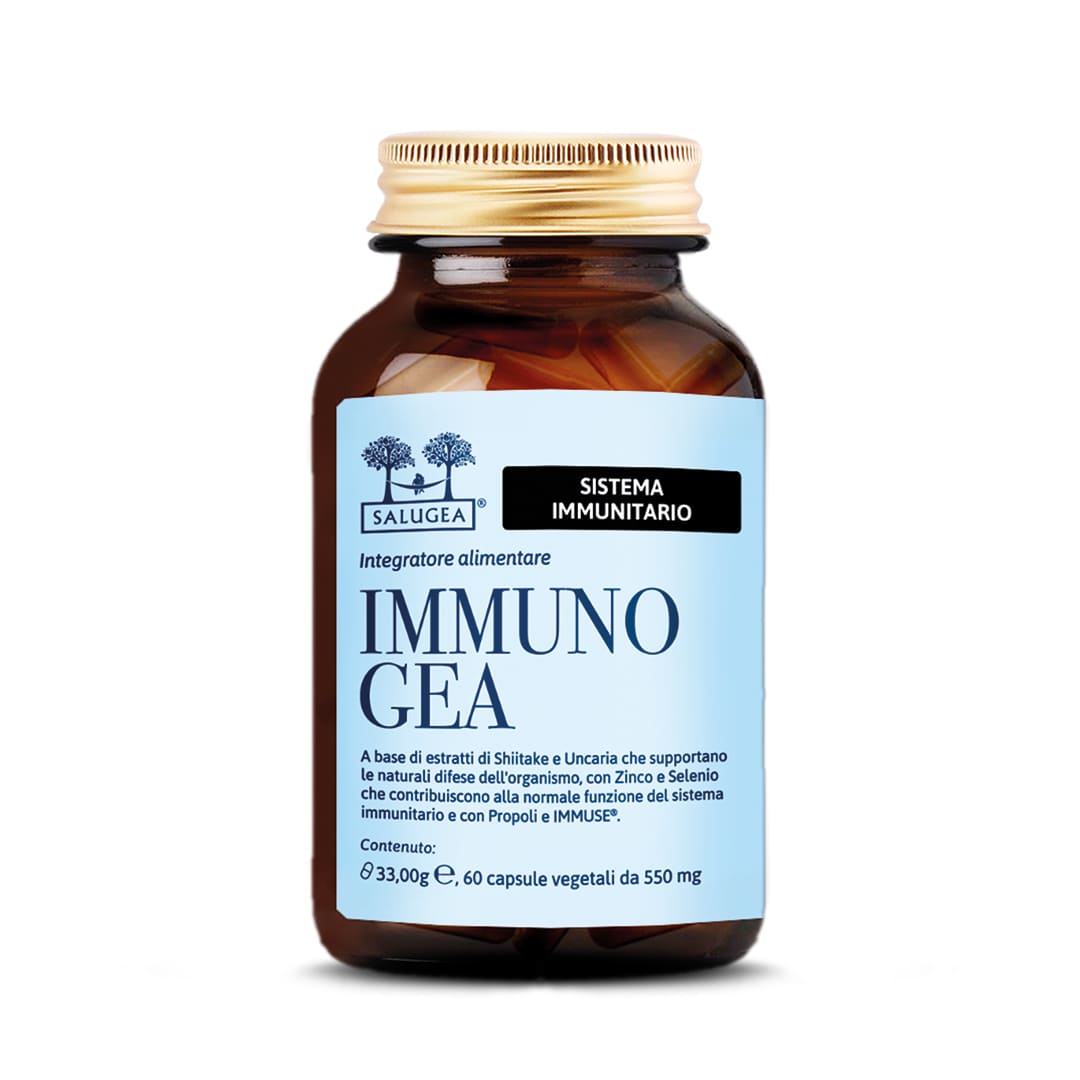
To help you carry out the mission, we at Salugea have selected 6 ingredients that are 100% natural – Uncaria, Shiitake, postbiotic Lactobacilli, dewaxed Propolis, Zinc and Selenium – and put them all together in the food supplement called ImmunoGea.
You may wonder why ImmunoGea does not contain Echinacea, Vitamin C or Lactoferrin that are usually included in most supplements for the immune system. Please read the answer hereunder.
Why have we decided not to include Echinacea, Vitamin C and Lactoferrin in the formulation of ImmunoGea?
- Echinacea is more effective when taken in the acute stages and for a very short length of time (7 to 10 days, maximum 15) whilst the ingredients in ImmunoGea support the immune system for long periods of time. A prolonged intake of Echinacea might not be as beneficial.
- Vitamin C and Lactoferrin are precious allies of our immune system. Yet, they are effective if taken in considerable quantity which would leave no room, in our capsules, for other more functional and innovative ingredients.
To Vitamin C and Lactoferrin we have preferred far more innovative and effective ingredients such as postbiotic Lactobacilli and Shiitake beta-glucans. Zinc and Selenium in organic form (antioxidant action) complete the formulation of ImmunoGea.
Let’s consider now a few studies that have been carried out on the ingredients we have selected.
Experimental Phytotherapy
Uncaria
Winkler C, Wirleitner B, Schroecksnadel K, Schennach H, Mur E, Fuchs D. In vitro effects of two extracts and two pure alkaloid preparations of Uncaria tomentosa on peripheral blood mononuclear cells. Planta Med. 2004 Mar;70(3):205-10. doi: 10.1055/s-2004-815536. PMID: 15114496.
The in vitro study confirms that Uncaria tomentosa extracts modulate the immunobiochemical pathways induced by interferon-gamma (a powerful immune mediator). Findings suggest a potential application of the extracts as immunoregulators, according to the observation of patients taking Uncaria extracts to optimize their immune response.
Lamm S, Sheng Y, Pero RW. Persistent response to pneumococcal vaccine in individuals supplemented with a novel water soluble extract of Uncaria tomentosa, C-Med-100. Phytomedicine. 2001 Jul;8(4):267-74. doi: 10.1078/0944-7113-00046. PMID: 11515716.
This clinical study aimed to test Uncaria extracts on patients undergoing pneumococcal vaccination. The results showed an increased response to vaccination and a longer lasting antibody titer immunity.
Shiitake and beta-glucans
Novak M, Vetvicka V. Beta-glucans, history, and the present: immunomodulatory aspects and mechanisms of action. J Immunotoxicol. 2008 Jan;5(1):47-57. doi: 10.1080/15476910802019045. PMID: 18382858.
This review takes into account studies on beta-glucans and shows that beta-glucans from medicinal mushrooms like Shiitake possess a special biochemical structure [beta-(1 → 3,1 → 6)] enabling them to be far more effective on immune defenses that the ones found in barley, oat and yeasts.
Vlassopoulou M, Yannakoulia M, Pletsa V, Zervakis GI, Kyriacou A. Effects of fungal beta-glucans on health - a systematic review of randomized controlled trials. Food Funct. 2021 Apr 26;12(8):3366-3380. doi: 10.1039/d1fo00122a. PMID: 33876798.
This is a review of 34 studies on the effects that beta-glucans from mushrooms have on health. The review confirms that supplementation with beta-(1 → 3,1 → 6)-d-glucans (like the ones from Shiitake) is well tolerated and the immune system response is boosted.
Rodriguez JAM, Bifano M, Roca Goma E, Plasencia CM, Torralba AO, Font MS, Millán PR. Effect and Tolerability of a Nutritional Supplement Based on a Synergistic Combination of β-Glucans and Selenium- and Zinc-EnrichedSaccharomyces cerevisiae(ABB C1®) in Volunteers Receiving the Influenza or the COVID-19 Vaccine: A Randomized, Double-Blind, Placebo-Controlled Study. Nutrients. 2021 Dec 2;13(12):4347. doi: 10.3390/nu13124347. PMID: 34959898; PMCID: PMC8708701.
This clinical study compares the effects of a mix of beta-glugans (1-3,1-6), selenium and zinc against a placebo on a group of 72 volunteers after they received vaccination against influenza and Covid-19. Results confirm that the mix of beta-glucans, selenium and zinc stimulates the acquired immunity thus granting a higher immunity in terms of specific serum antibodies.
Propolis
Zulhendri F, Chandrasekaran K, Kowacz M, Ravalia M, Kripal K, Fearnley J, Perera CO. Antiviral, Antibacterial, Antifungal, and Antiparasitic Properties of Propolis: A Review. Foods. 2021 Jun 11;10(6):1360. doi: 10.3390/foods10061360. PMID: 34208334; PMCID: PMC8231288
This comprehensive review outlines the antiviral, antibacterial and immunomodulating properties of propolis which can sustain innate immunity and modulate the inflammation-signaling pathways. Besides, according to the review, Propolis has a remarkable antioxidant action that also contributes to the immune system health.
Esposito C, et al. A standardized polyphenol mixture extracted from poplar-type propolis for remission of symptoms of uncomplicated upper respiratory tract infection (URTI): A monocentric, randomized, double-blind, placebo-controlled clinical trial. Phytomedicine. 2021 Jan;80:153368. doi: 10.1016/j.phymed.2020.153368. Epub 2020 Oct 8. PMID: 33091857.
This 8-week Italian study was carried out on 122 healthy adults with mild upper respiratory tract infections (URTI) - such as sore throat, hoarse voice and swelling due to a bacterial or viral acute infection. Participants were randomly assigned to receive either propolis or a placebo.
The results showed that Propolis is effective on mild viral or bacterial URTI and that recovery is shortened, thus leading to a prompt symptom resolution.
Postbiotic Lactobacilli (Lactococcus lactis JCM 5805)
Takeo Shibata, et al. Lactococcus lactis JCM5805 activates anti-viral immunity and reduces symptoms of common cold and influenza in healthy adults in a randomized controlled trial, Journal of Functional Foods, Volume 24, 2016, Pages 492-500, ISSN 1756-4646, https://doi.org/10.1016/j.jff.2016.03.035. (https://www.sciencedirect.com/science/article/pii/S175646461630072X)
This clinical study was conducted on a group of 396 healthy adults to evaluate the effect of heat-inactivated Lactococcus lactis JCM5805 on common colds and influenza. Participants were randomly assigned either the postbiotic or a placebo for 12 weeks. Compared against the placebo group, the test group took a significantly lower number of days to recover from sore throat and cough. Results suggests that postbiotic lactobacilli stimulate the antiviral activity of pDCs to lower the incidence of the most common symptoms of cold and flu.
Sugimura T, et al. Effects of oral intake of plasmacytoid dendritic cells-stimulative lactic acid bacterial strain on pathogenesis of influenza-like illness and immunological response to influenza virus. Br J Nutr. 2015 Sep 14;114(5):727-33. doi: 10.1017/S0007114515002408. Epub 2015 Aug 3. PMID: 26234407.
This clinical study tested the effects of oral intake of plasmacytoid dendritic cells-stimulative lactic acid bacterial strain on pathogenesis of influenza-like illness and immunological response to influenza virus.
A total of 213 volunteers were divided into two groups, which received either yogurt made with L. lactis JCM5805 or a placebo beverage daily for 10 weeks. In the JCM5805 group, the cumulative incidence days of 'cough' and 'feverishness', which are defined as major symptoms of an influenza-like illness, were significantly decreased compared with the placebo group.
These results suggest that intake of JCM5805 can prevent the pathogenesis of an influenza-like illness via enhancement of an IFN-α-mediated response to the influenza virus.
Zinc
Barnett JB, et al. Effect of zinc supplementation on serum zinc concentration and T cell proliferation in nursing home elderly: a randomized, double-blind, placebo-controlled trial. Am J Clin Nutr. 2016 Mar;103(3):942-51. doi: 10.3945/ajcn.115.115188. Epub 2016 Jan 27. PMID: 26817502.
The aim of the clinical study was to assess if Zinc supplementation has the potential to improve the serum zinc concentrations and immunity in elderly with a low serum zinc concentration. The study was conducted on 53 nursing home elderly for 3 months. The participants were randomly assigned zinc and placebo. Results confirmed the increase in serum zinc concentration which was associated with the enhancement of T cell function mainly because of an increase in the number of T cells.
Selenium
Goldson AJ, et al. Effects of selenium supplementation on selenoprotein gene expression and response to influenza vaccine challenge: a randomised controlled trial. PLoS One. 2011 Mar 21;6(3):e14771. doi: 10.1371/journal.pone.0014771. PMID: 21445287; PMCID: PMC3061857.
The aim of this clinical study was to determine the effects of selenium supplementation on selenoprotein gene expression and response to the influenza vaccine.
119 participants were randomly assigned placebo or selenium-enriched yeast or onions. Results obtained at the end of the 12-week test confirmed the role of selenoprotein S (SEPS1) in the immune response, and the relationship between selenium serum levels and immune function.
Thiel RJ. Natural vitamins may be superior to synthetic ones. Med Hypotheses. 2000 Dec;55(6):461-9. doi: 10.1054/mehy.2000.1090. PMID: 11090291.
Clardy J, Walsh C. Lessons from natural molecules. Nature. 2004 Dec 16;432(7019):829-37. doi: 10.1038/nature03194. PMID: 15602548.
DISCLAIMER
Our texts are for information purposes only and should not be considered as indications for diagnosis and treatment of pathological conditions. They cannot replace your physician’s advice.
Our texts are for information purposes only; they are not to be understood as an indication for the diagnosis and treatment of medical conditions and are in no way intended to replace the advice of a doctor.