Its identifying acronym is GERD[3] but to many it is better known as Gastro-oesophageal Reflux Disease.
A debilitating and, unfortunately, very widespread disorder that affects, even sporadically, up to 33% of people, often including the young[4].
And its tell-tale signs are very clear too:
- Stomach acidity
- Impaired function of the cardia, the oesophageal sphincter (the valve that closes the stomach at the top)
- Acid belching
- Retrosternal heartburn
- Globus sensation, the feeling of a lump in the throat
- Cough or other throat discomfort caused by acids rising back up
Complaints that worsen when the person is sitting/lying down and/or after meals.
What are the causes that lead a person to suffer from reflux?
We could say that gastro-oesophageal reflux is a disorder born of modern life:
Hectic lifestyles and poor dietary and behavioural habits: consumption of acidifying and fatty foods. Coffee, fizzy drinks and alcohol.
- Smoking
- Continuous stress and nervous tension, every day, both at work and at home
- Hiatus hernia
- Weight gain
And what does the market offer for this need?
Most of the supplements on the market focus on a solution that temporarily “buffers” acidity.
However, this approach only provides momentary relief, because as soon as the effect of the salts wears off the situation returns just as before.
A phytotherapeutic treatment that acts positively on these conditions must be based on:
- Buffering acids and regulating acid secretion
- Physically protecting the stomach walls by creating a protective film
- Supporting the regeneration of the gastric mucosa
- Also considering the emotional, stress-related side
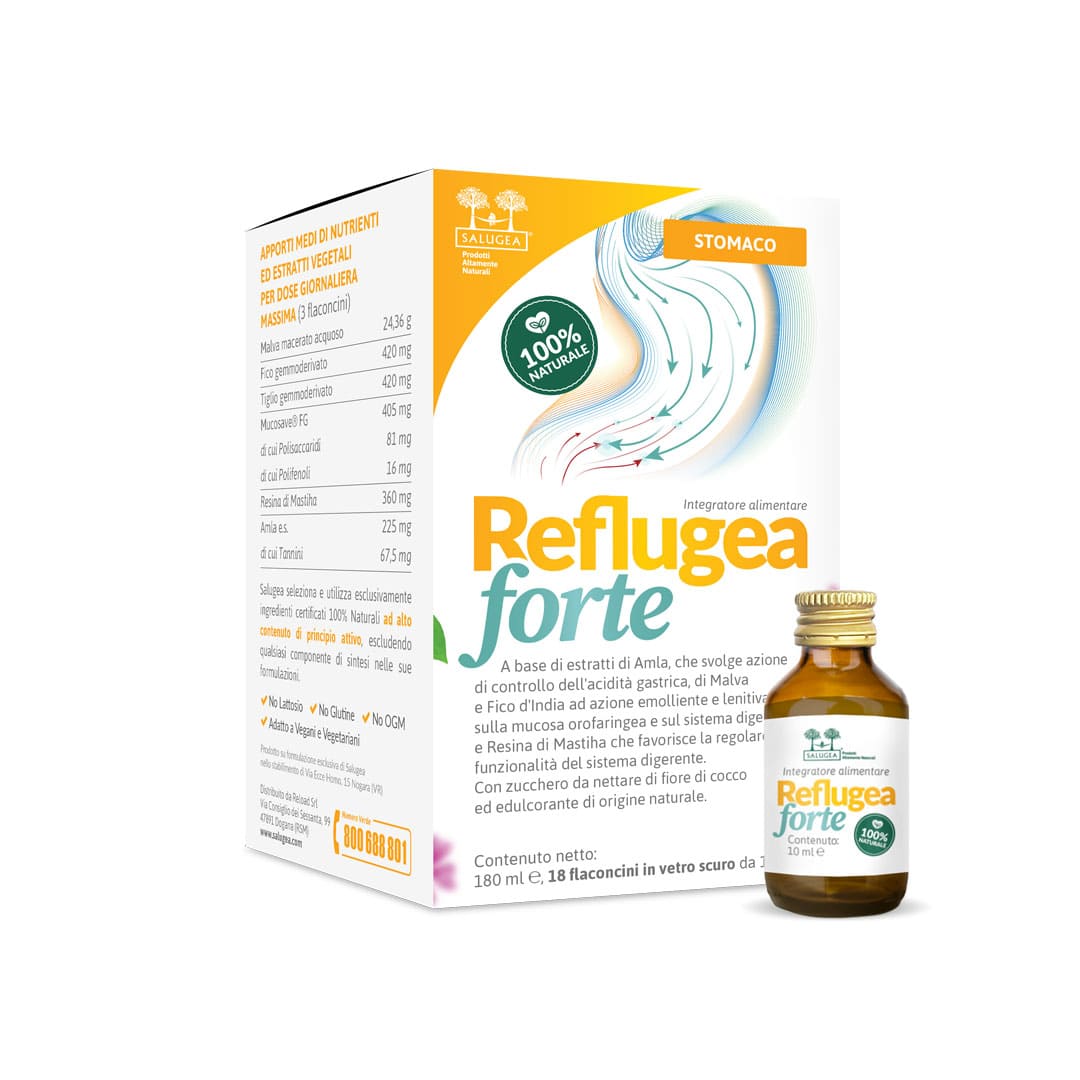
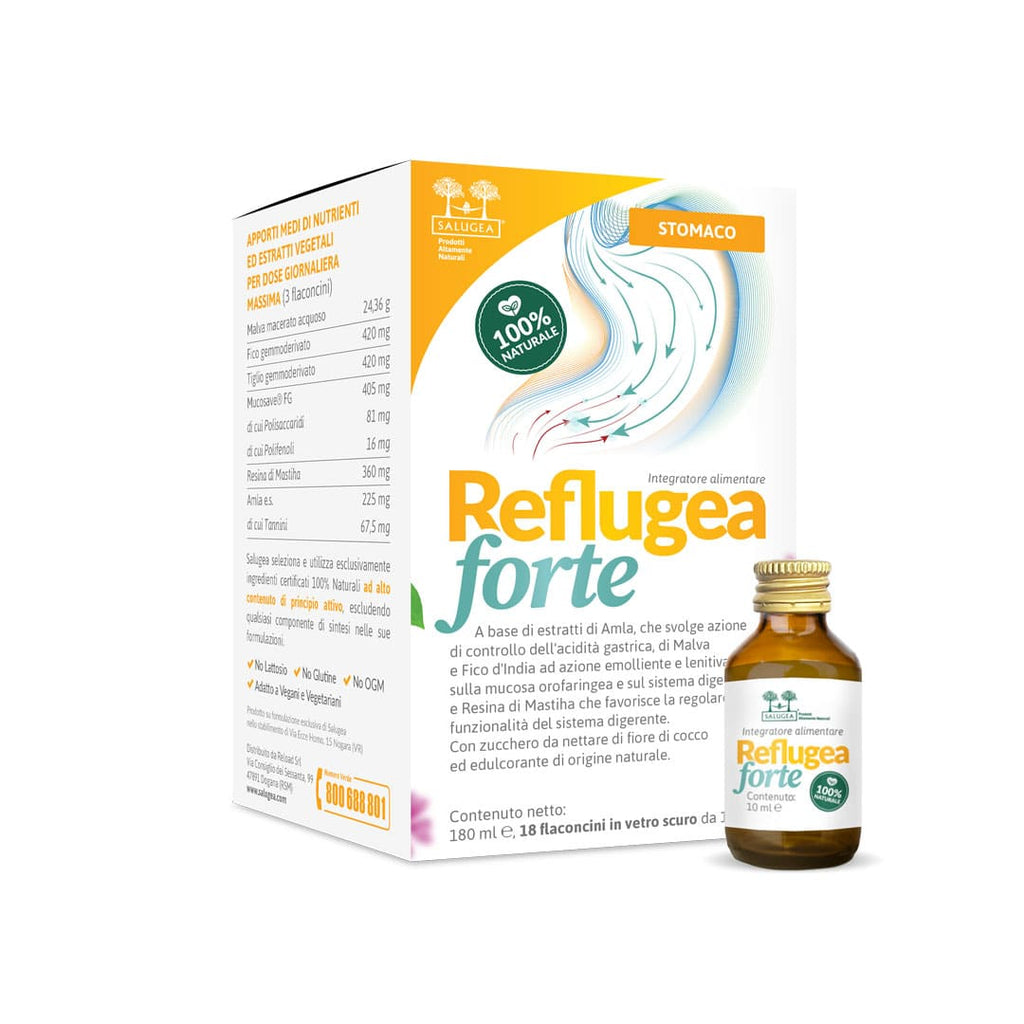
It was on the basis of this philosophy that Reflugea Forte was born: its active ingredients do not merely buffer the situation but allow control of acid secretion and the regeneration of the gastric mucosa.
All this while also considering the emotional side, an essential aspect given that body, mind and environment are an ever more united whole.
EXPERIMENTAL PHYTOTHERAPY
Mallow
- Mousavi SM et al. A Review on Health Benefits of Malva sylvestris L. Nutritional Compounds for Metabolites, Antioxidants, and Anti-Inflammatory, Anticancer, and Antimicrobial Applications. Evid Based Complement Alternat Med. 2021 Aug 14;2021:5548404. doi: 10.1155/2021/5548404. PMID: 34434245; PMCID: PMC8382527.
A review of various studies on the different uses and benefits of Mallow, highlighting its antimicrobial, epithelium-protective and antioxidant properties.
- Hamedi A et al. Effects of Malva sylvestris and Its Isolated Polysaccharide on Experimental Ulcerative Colitis in Rats. J Evid Based Complementary Altern Med. 2016 Jan;21(1):14-22. doi: 10.1177/2156587215589184. Epub 2015 Jun 4. PMID: 26045553.
In this study, carried out on animals, researchers highlighted the positive effects of Mallow on ulcerative colitis. In particular, at the end of the study, the authors proposed Mallow both as a remedy and as an adjuvant to limit the negative effects of the medicines used for this disorder.
Mucosave® FG
- Alecci U, Bonina F, Bonina A, Rizza L, Inferrera S, Mannucci C, Calapai G. Efficacy and Safety of a Natural Remedy for the Treatment of Gastroesophageal Reflux: A Double-Blinded Randomized-Controlled Study. Evid Based Complement Alternat Med. 2016;2016:2581461. doi: 10.1155/2016/2581461. Epub 2016 Oct 12. PMID: 27818697; PMCID: PMC5080480
A double-blind placebo-controlled clinical study in which 55 subjects took an antacid preparation with the addition of Mucosave® FG, compared with another 53 who took only the base preparation, for 2 months. At the end of the test, the subjects using Mucosave achieved a 56.5% greater improvement in gastric pain and dysphagia than the placebo subjects, and 59.1% better results for acid regurgitation, belching, nausea and cough.
- Galati EM et al. Antiulcer activity of Opuntia ficus indica (L.) Mill. (Cactaceae): ultrastructural study. J Ethnopharmacol. 2001 Jun;76(1):1-9. doi: 10.1016/s0378-8741(01)00196-9. PMID: 11378276.
Electron microscope observation of the gastric mucosa protected by the mucilage of the Prickly Pear leaf showed an anti-ulcer effect in animals. The action of the mucilage of Prickly Pear leaves is probably at the root of this effect.
- Al-Quraishy S et al. Olive (Olea europaea) leaf methanolic extract prevents HCl/ethanol-induced gastritis in rats by attenuating inflammation and augmenting antioxidant enzyme activities. Biomed Pharmacother. 2017 Jul;91:338-349. doi: 10.1016/j.biopha.2017.04.069. Epub 2017 May 2. PMID: 28463797.
The results of this work on animals clearly showed that Olive leaf extract can prevent HCl/ethanol-induced gastritis by attenuating inflammation and the oxidant/antioxidant imbalance. Indeed, olive leaf extract, thanks to its polyphenols, can be useful as a natural treatment for gastritis.
Mastiha Resin
- Dabos K.J. et al. [2010]: Is Chios mastic gum effective in the treatment of functional dyspepsia? A prospective randomised double-blind placebo controlled trial. J of Ethnopharmacology, 127 (2): 205–209.
In this placebo-controlled clinical study, the positive action of Mastiha Resin on dyspepsia caused by gastric hyperacidity was verified. The use of this active ingredient showed the ability to contain stomach ache in general and, in cases of anxiety, the perception of dull pain in the upper abdomen and heartburn. Chios mastic therefore significantly improves symptoms in patients with functional dyspepsia compared with placebo.
- Dabos KJ, Sfika E, Vlatta LJ, Giannikopoulos G. The effect of mastic gum on Helicobacter pylori: a randomized pilot study. Phytomedicine. 2010 Mar;17(3-4):296-9. doi: 10.1016/j.phymed.2009.09.010. Epub 2009 Oct 29. PMID: 19879118
In this study carried out on people, researchers tested the effects of Mastiha resin on Helicobacter pylori, confirming its beneficial effects against this bacterium as well.
Amla
- Al-Rehaily AJ, Al-Howiriny TA, Al-Sohaibani MO, Rafatullah S. Gastroprotective effects of 'Amla' Emblica officinalis on in vivo test models in rats. Phytomedicine. 2002 Sep;9(6):515-22. doi: 10.1078/09447110260573146. PMID: 12403160.
A study showing that Amla is able to block the development of lesions in the stomach and its walls and to reduce excess gastric secretions.
- Karkon Varnosfaderani S. et al. Efficacy and safety of Amla (Phyllanthus emblica L.) in non-erosive reflux disease: a double-blind, randomized, placebo-controlled clinical trial. J Integr Med. 2018 Mar;16(2):126-131. doi: 10.1016/j.joim.2018.02.008. Epub 2018 Feb 13. PMID: 29526236.
A double-blind clinical study showing that Amla is useful in reducing the frequency of belching, heartburn and the intensity of this discomfort.
N.B. Our texts are for information purposes only; they are not to be understood as an indication for the diagnosis and treatment of medical conditions, and are in no way intended to replace the advice of a doctor.
[1] Alecci U, Bonina F, Bonina A, Rizza L, Inferrera S, Mannucci C, Calapai G. Efficacy and Safety of a Natural Remedy for the Treatment of Gastroesophageal Reflux: A Double-Blinded Randomized-Controlled Study. Evid Based Complement Alternat Med. 2016;2016:2581461. doi: 10.1155/2016/2581461. Epub 2016 Oct 12. PMID: 27818697; PMCID: PMC5080480
[2] A.J. Al-Rehaily, T.S. Al-Howiriny, M.O. Al-Sohaibani, S. Rafatullah, Gastroprotective effects of ‘Amla’ Emblica officinalis on in vivo test models in rats, Phytomedicine, https://doi.org/10.1078/09447110260573146. (https://www.sciencedirect.com/science/article/pii/S0944711304701506).
[3] Mayo Clinic - Diseases & Conditions - Gastroesophageal reflux disease (GERD).
[4] Zhang T, Tian W, Wei Y, Wang F, Yin X, Wei X, Liu J, Tang X. Trends in gastroesophageal reflux disease research: A bibliometric and visualized study. Frontiers in Medicine. 2022;9:994534. doi:10.3389/fmed.2022.994534.
Our texts are for information purposes only; they are not to be understood as an indication for the diagnosis and treatment of medical conditions and are in no way intended to replace the advice of a doctor.