The gut: our "second brain"
Have you ever heard the gut described as our "second brain"? This definition – which first appeared in 1999, in the book by the neurobiologist Michael D. Gershon, professor of Pathology and Cell Biology at Columbia University, known as the "father of neuro-gastroenterology" – stems from the fact that inside our gut there is a network of neurons identical to those of the brain, which form the so-called enteric nervous system and interact with the central and autonomic nervous systems.
Put simply, the gut and the brain communicate with and influence each other continuously. That is why we speak of the functional gut-brain axis.
Now, within the scientific research studying the connection between the enteric nervous system and mental wellbeing, centre stage is taken by the so-called "psychobiotics". Meaning what, exactly?
The gut and emotional wellbeing: psychobiotics
Psychobiotics are defined as probiotics useful for mood, that is, probiotics that can have a beneficial influence on mental functions. The study of their mechanisms of action is at the centre of research and we already have several interesting pieces of information, for example the fact that probiotics play a role in countering inflammatory phenomena, phenomena that underlie many pathologies, including mental ones, since they alter the functioning of the affected organs.
Not only that: psychobiotics produce, at gut level, substances that act on the brain, such as serotonin, the so-called "happiness hormone", and γ-aminobutyric acid (GABA), an important neurotransmitter involved in modulating the responses relating above all to stress-related anxiety. These substances can activate intestinal cells, which in turn release molecules that stimulate brain function and influence behaviour.
In short, psychobiotics really are a very promising field for the support of emotional wellbeing.
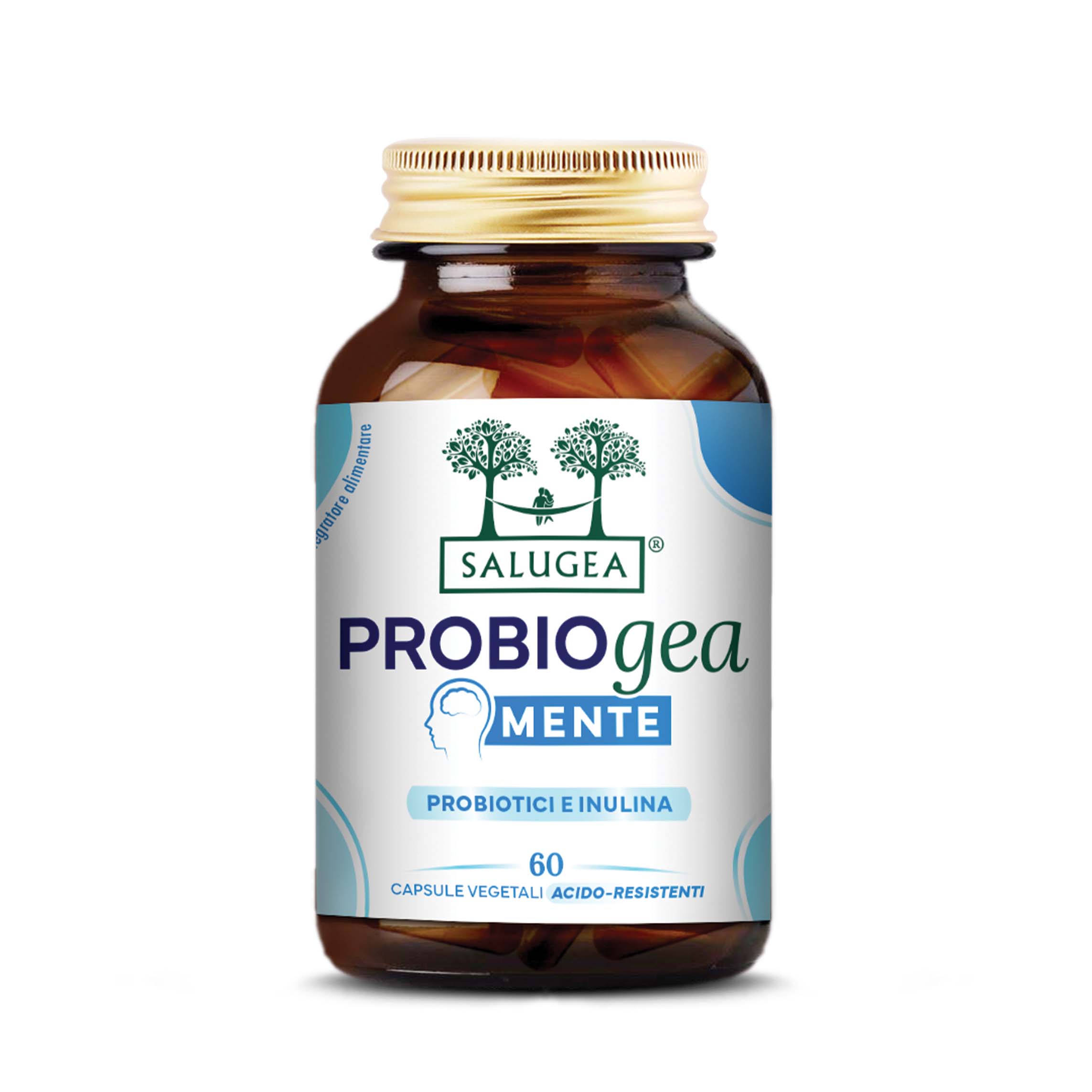
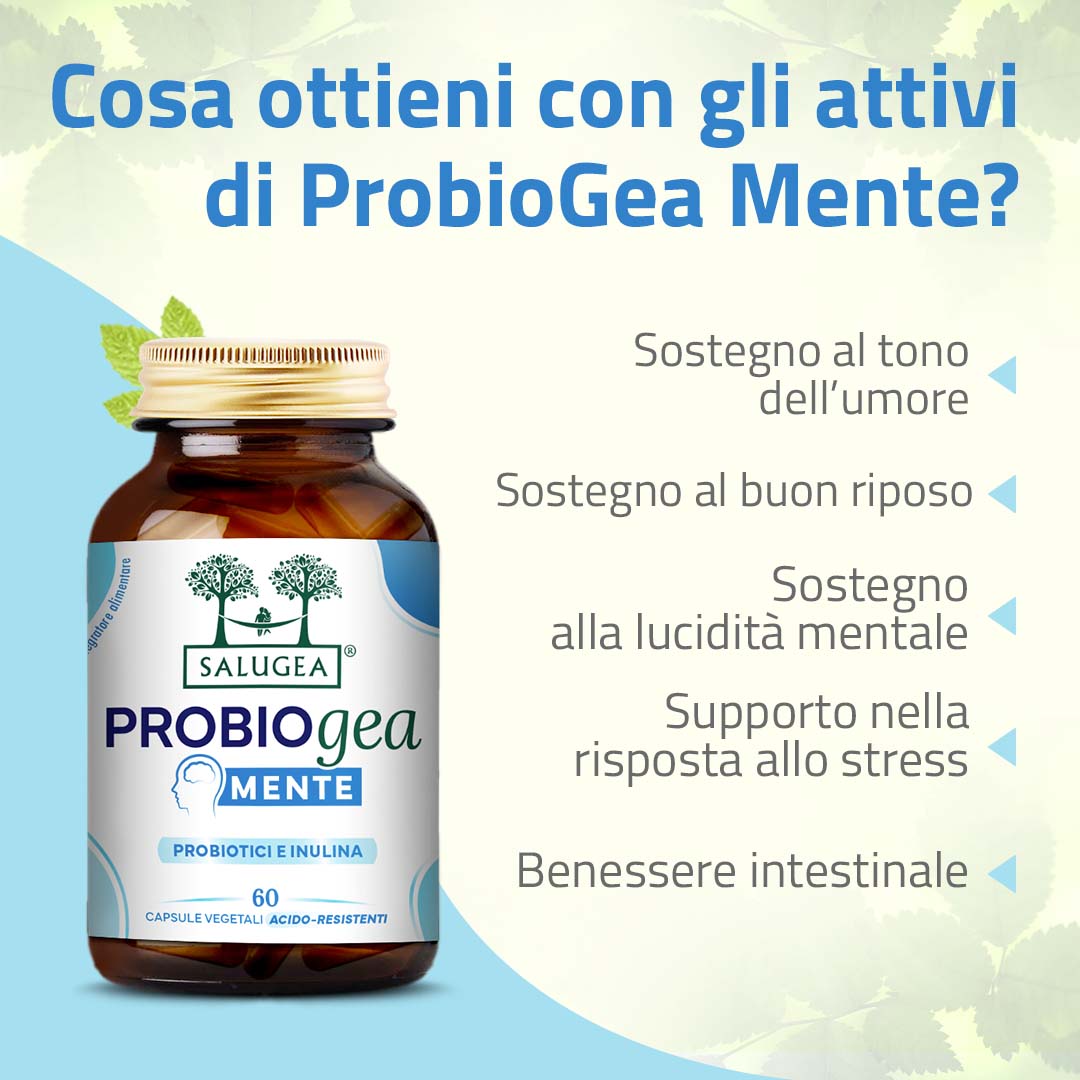
To find out more, below you will find some studies conducted on the psychobiotics we have selected for ProbioGea Mente.
Scientific Bibliography
Patented Probiotic Mix: Limosilactobacillus reuteri PBS072, Bifidobacterium breve BB077
Nobile V, Giardina S, Puoci F. The Effect of a Probiotic Complex on the Gut-Brain Axis: A Translational Study. Neuropsychobiology. 2022;81(2):116-126. doi: 10.1159/000518385. Epub 2021 Aug 30. PMID: 34515196.
This study verified, through in vitro tests, some of the mechanisms of action of the probiotic complex. It was seen that its probiotic strains, through the processing of certain metabolic agents, reduce the levels of LSD1, an enzyme present at neuronal level which is expressed when there is a phase of stress and converts stressful stimuli into anxious behaviour. In addition, one test showed that the metabolites deriving from the probiotic strains of the mix not only restored but also significantly increased the concentration of GABA after stress induction (remember that GABA, or γ-aminobutyric acid, is a neuronal mediator that is very important for modulating the responses relating above all to stress-induced anxiety). Finally, in an in vitro test on intestinal cells cultured with cortisol (a stress agent), it was seen that the levels of serotonin (another important neurotransmitter, known above all in the context of depressive states) knocked down by cortisol were almost totally restored by the strains of the probiotic mix.
In this same work, we also find an interesting clinical study that involved 30 students aged between 18 and 30, selected on the basis of self-reported conditions of stress during a period of preparation for exams. The results suggest that, during stress tests, the probiotics provided promote attention, concentration and mental flexibility (problem solving); they promote intellectual responsiveness, improving short-term memory; and they have a positive effect on quality of life, an effect shown by the improvement in sleep quality and in the perception of anxiety.
Nobile V, Puoci F. Effect of a Multi-Strain Probiotic Supplementation to Manage Stress during the COVID-19 Pandemic: A Randomized, Double-Blind, Placebo-Controlled, Cross-Over Clinical Trial. Neuropsychobiology. 2023;82(2):61-71. doi: 10.1159/000527956. Epub 2023 Jan 12. PMID: 36634645; PMCID: PMC9843736.
Another significant placebo-controlled clinical study tested the use of the probiotic compound on 33 healthy subjects of both sexes (25-60 years) exposed to ordinary work-related stress. Sleep quality and mood state were monitored, and various psychophysical parameters of the subjects (anger, tension, depression, fatigue, confusion and vigour) were assessed through a questionnaire. It proved to positively modulate the mood of the subjects tested, with a significant reduction in feelings of both anger and nervous tension, and to significantly improve sleep quality.
Vicariotto F, Malfa P, Torricelli M, Lungaro L, Caio G, De Leo V. Beneficial Effects of Limosilactobacillus reuteri PBS072 and Bifidobacterium breve BB077 on Mood Imbalance, Self-Confidence, and Breastfeeding in Women during the First Trimester Postpartum. Nutrients. 2023 Aug 9;15(16):3513. doi: 10.3390/nu15163513. PMID: 37630704; PMCID: PMC10458832.
Another important field of application of the probiotic complex is that of supporting women during the post-partum and breastfeeding periods, times when the onset of anxious-depressive states linked to the new and demanding condition being experienced can be frequent. This interesting multicentre clinical study was carried out on a total of 200 new mothers (within the first post-partum trimester) aged from 18 to 50, who were breastfeeding. Randomly divided into the test group and the placebo group, the former took the mix for 90 days, while the latter took an inert product. The mothers' mood and quality of life, the quality of breastfeeding and the assessment of the baby's crying were monitored.
The probiotic blend proved to significantly support the mothers' mood compared with the placebo. In addition, a significant improvement in breastfeeding performance was seen in the new mothers, maintaining a positive trend throughout the treatment, with +24% compared with the control group. An improvement in the baby's response to breastfeeding was also observed, with a significant reduction in the incidence of crying episodes (-80% versus -40% in the control group) – this is because, in the first 6 months of life, the change in the composition of breast milk, mediated by the gut and skin microbiota, can positively influence the baby's gut microbiota, with reduced gas production and therefore a reduction in crying episodes.
Bifidobacterium longum
Boehme M, Rémond-Derbez N, Lerond C, et al. Bifidobacterium longum subsp. longum Reduces Perceived Psychological Stress in Healthy Adults: An Exploratory Clinical Trial. Nutrients. 2023 Jul 13;15(14):3122. doi: 10.3390/nu15143122. PMID: 37513541; PMCID: PMC10383821.
This work studied the effect of a 6-week intervention with Bifidobacterium longum on stress-related psychological and physiological parameters in 45 healthy adults of both sexes (25-65 years) with mild to moderate stress. The main results showed that supplementation with the probiotic significantly reduced perceived stress and improved the subjective sleep quality score compared with the placebo. Statistical analysis also indicated that a significant reduction in perceived stress correlated with a reduction in anxiety, depression and the cortisol awakening response. This evidence strengthens the hypotheses that treatments with specific probiotics can act positively on perceived stress and on its psychophysical repercussions on a person's wellbeing.
Wang H, Braun C, Murphy EF, Enck P. Bifidobacterium longum 1714™ Strain Modulates Brain Activity of Healthy Volunteers During Social Stress. Am J Gastroenterol. 2019 Jul;114(7):1152-1162. doi: 10.14309/ajg.0000000000000203. PMID: 30998517; PMCID: PMC6615936.
This study evaluated the effects of Bifidobacterium longum on the neural responses to social stress induced by the "Cyberball game" test (a social stress paradigm). 40 healthy volunteers received B. longum or a placebo for 4 weeks. B. longum modulated resting neural activity, correlating it with greater vitality and reduced mental fatigue. In addition, the probiotic positively modulated the neural responses during social stress, which could be involved in activating the brain centres that regulate negative emotions.
Lactobacillus helveticus
Kazemi A, Noorbala AA, Azam K, Eskandari MH, Djafarian K. Effect of probiotic and prebiotic vs placebo on psychological outcomes in patients with major depressive disorder: A randomized clinical trial. Clin Nutr. 2019 Apr;38(2):522-528. doi: 10.1016/j.clnu.2018.04.010. Epub 2018 Apr 24. PMID: 29731182.
Let us start with a premise, to better understand the results of this study: kynurenine is a substance produced during phases of stress and is a metabolite of tryptophan, the precursor of serotonin. If a person is going through a period of high stress, tryptophan is degraded to kynurenine; so, the higher the kynurenine-to-tryptophan ratio, the more we are in a state of physiological stress. Now, this interesting clinical study compared the effect of supplementation with probiotics and with a prebiotic against placebo in 81 volunteers with depressive disorders (mean age 36.5 ± 8 years). In the subjects who took a probiotic mix with Lactobacillus helveticus and Bifidobacterium longum (both present in ProbioGea Mente), a reduction of almost 50% in the clinical score was seen, compared with the placebo. In addition, there was an improvement in the kynurenine/tryptophan and tryptophan/amino acids ratios. All this, in just 8 weeks of treatment.
Messaoudi M, Lalonde R, Violle N, et al. Assessment of psychotropic-like properties of a probiotic formulation (Lactobacillus helveticus R0052 and Bifidobacterium longum R0175) in rats and human subjects. Br J Nutr. 2011 Mar;105(5):755-64. doi: 10.1017/S0007114510004319. Epub 2010 Oct 26. PMID: 20974015.
In this clinical work on 55 healthy volunteers of both sexes, a probiotic mix consisting of Lactobacillus helveticus and Bifidobacterium longum, or a placebo, was administered for 30 days. The subjects were assessed at the start and end of treatment with the Hopkins Symptom Checklist (HSCL-90), a test that analyses a wide range of psychopathological disorders; the Hospital Anxiety and Depression Scale (HADS), which measures psychological distress in subjects with somatic or psychosomatic disorders; the Perceived Stress Scale (PSS), which assesses the degree to which recent life situations are judged to be stressful; the Coping Checklist (CCL), which measures 5 types of strategies used when facing an adverse event (problem solving; avoidance with wishful thinking; seeking social support; positive reappraisal; a tendency to self-blame); and 24-hour urinary free cortisol (UFC). Administration of the probiotic mix relieved psychological distress in the volunteers, significantly improving the parameters of the HSCL-90 checklist (for global severity index, somatisation, depression and anger-hostility), of the HADS (for overall score and anxiety) and of the CCL level (problem solving), and reducing urinary UFC cortisol. Therefore L. helveticus and B. longum taken in combination show anxiolytic-like activity and beneficial psychological effects.
Inulin from Chicory
Qin YQ, Wang LY, Yang XY, et al. Inulin: properties and health benefits. Food Funct. 2023 Apr 3;14(7):2948-2968. doi: 10.1039/d2fo01096h. PMID: 36876591.
This review of studies focuses on the function of Inulin and its health benefits. As well as citing this substance's recognised prebiotic activity and, therefore, its contribution to the balance of the gut microbiota, many other benefits of inulin are mentioned: among them, its beneficial action in alleviating depressive states.
Hughes RL, Alvarado DA, Swanson KS, Holscher HD. The Prebiotic Potential of Inulin-Type Fructans: A Systematic Review. Adv Nutr. 2022 Mar;13(2):492-529. doi: 10.1093/advances/nmab119. Epub 2023 Feb 10. PMID: 34555168; PMCID: PMC8970830.
This review of studies confirms the prebiotic effect of Inulin on the gut microbiota (through the promotion of the levels of bifidobacteria and lactobacilli) and its beneficial action for the function of the intestinal barrier.
N.B. Our texts are for information purposes only; they are not to be understood as an indication for the diagnosis and treatment of medical conditions and are in no way intended to replace the advice of a doctor.
Our texts are for information purposes only; they are not to be understood as an indication for the diagnosis and treatment of medical conditions and are in no way intended to replace the advice of a doctor.