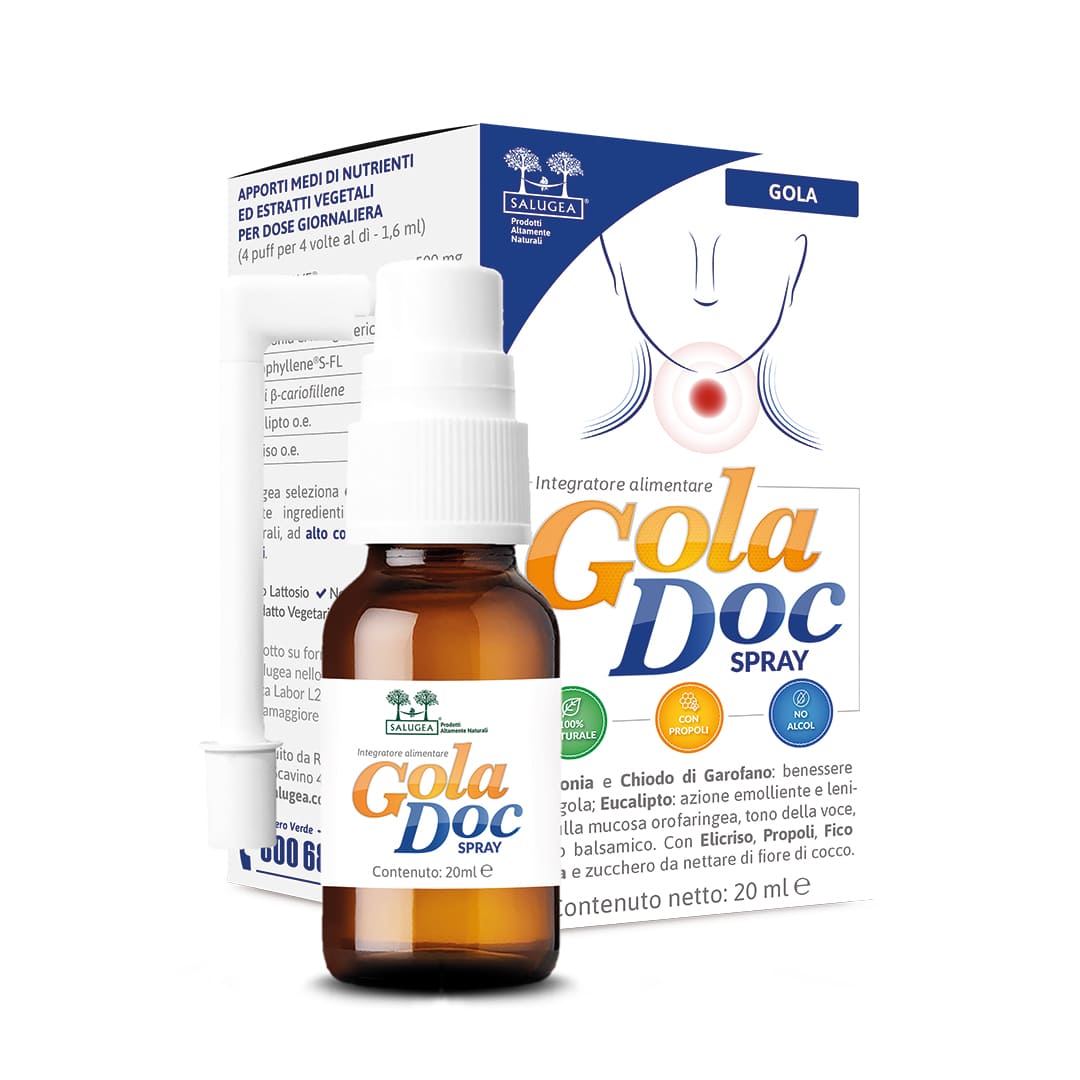
A sore throat is a kind of “ailment” we learn to deal with from a very early age.
Thinking back, many will remember staying home from school with a bad sore throat, or having a sore throat so severe that even swallowing saliva was difficult.
Even though as adults a sore throat may strike less frequently, the unease and discomfort are always the same. That is why, as soon as we start to feel that tingling in the throat or difficulty swallowing, we rightly run for cover.
But what does “sore throat” mean in detail? How long does it last? Are there factors that can predispose us more easily to a sore throat?
Let us analyse these aspects.
What does “sore throat” mean?
A sore throat is a complaint characterised by inflammation and pain in the posterior pharynx, occurring in association or not with swallowing, difficulty speaking and a dry throat.
So we begin to see that within the words “sore throat” there are, in reality, several protagonists of the oral cavity: the pharynx, larynx, tonsils and adenoids.
Pain and inflammation can involve one or more of these areas. That is why we can speak of tonsillitis, pharyngitis and laryngitis. The most common symptom, as we mentioned, is pain, which may or may not be associated with difficulty swallowing.
We tend to think that a sore throat is a typically winter phenomenon and, indeed, for the most part it is the colder months that put the throat under pressure. But in recent years, summer too has been marked by frequent sore throats.
The reason, as you can easily imagine, lies in the temperature swings you experience when moving from a very warm environment to a colder one and vice versa.
Well, these swings are harmful for our throat.
The various kinds of sore throat can be caused by respiratory viruses (rhinovirus, adenovirus, influenza viruses, coronavirus, respiratory syncytial virus) or by bacteria (the most common being Streptococcus)
How long does a sore throat last?
In general, a sore throat is an acute, transitory complaint that clears up within a week1. There are, however, causes that can make the discomfort last for weeks or even months, to the point of becoming chronic.
What are the factors that expose us most to a sore throat?
Certainly the winter period, which in itself brings a greater circulation of viruses and bacteria, is suspect number one among the causes of a sore throat.
But there are other everyday situations that can expose our throat to difficulties.
In particular:
- Allergies to inhalants (pet hair, moulds, dust and pollen);
- Dry air in enclosed spaces;
- Chronic inhalation of irritating substances (polluted air, cigarette smoke, toxic fumes from certain industrial plants);
- Drinking alcohol and eating spicy foods;
- Shouting, speaking loudly or for long periods without rest;
- Having pharyngeal reflux (a disorder of the digestive system in which stomach acids flow back into the oesophagus and then reach the pharynx);
Let us now see how Mother Nature can help us in these conditions and what the studies say about the plant actives we have chosen for Goladoc.
Experimental Phytotherapy
PROPOLSAVE®
Bosio K, Avanzini C, D'Avolio A, Ozino O, Savoia D. In vitro activity of propolis against Streptococcus pyogenes. Lett Appl Microbiol. 2000 Aug;31(2):174-7. doi: 10.1046/j.1365-2672.2000.00785.x. PMID: 10972723.
This Italian study, carried out by the University of Turin, verified, in vitro, the inhibiting and bactericidal action of 2 Propolis preparations on the growth of 46 different strains of Streptococcus. The Propolis preparation proved effective on the various strains studied, inhibiting their development.
Di Pierro F, Zanvit A, Colombo M. Role of a proprietary propolis-based product on the wait-and-see approach in acute otitis media and in preventing evolution to tracheitis, bronchitis, or rhinosinusitis from nonstreptococcal pharyngitis. Int J Gen Med. 2016 Nov 11;9:409-414. doi: 10.2147/IJGM.S118967. PMID: 27956842; PMCID: PMC5113938.
Another Italian study, which highlighted the action of a Propolis extract on 56 children affected by non-streptococcal sore throat and otitis media of viral origin. The results showed that the use of propolis supplements for 72 hours reduces the severity of otitis and viral pharyngitis, reduces the use of antipyretics and anti-inflammatory drugs and decreases the rate of evolution into tracheitis, bronchitis and rhinosinusitis. The researchers conclude by suggesting that propolis can be used as a safe additional therapy in cases of viral otitis media and/or pharyngitis.
Zeghbib W, Boudjouan F, Vasconcelos V, Lopes G. Phenolic Compounds' Occurrence in Opuntia Species and Their Role in the Inflammatory Process: A Review. Molecules. 2022 Jul 25;27(15):4763. doi: 10.3390/molecules27154763. PMID: 35897933; PMCID: PMC9330797.
In this review the researchers reported the evidence highlighting how the Opuntia species, which include the Prickly Pear, contain several classes of phenolic compounds recognised for their anti-inflammatory potential.
The use of an extract of Prickly Pear cladodes, therefore, can prove useful in its soothing and decongestant action on the mucous membranes of the upper airways.
Furthermore, the barrier action that the mucopolysaccharides of the Prickly Pear can exert on the mucous membranes further aids the protective and regenerative phenomena of the epithelia of the upper respiratory tract.
Endophyllene®-S FL
Quintans-Júnior LJ, Araújo AA, Brito RG, Santos PL, Quintans JS, Menezes PP, Serafini MR, Silva GF, Carvalho FM, Brogden NK, Sluka KA. β-caryophyllene, a dietary cannabinoid, complexed with β-cyclodextrin produced anti-hyperalgesic effect involving the inhibition of Fos expression in superficial dorsal horn. Life Sci. 2016 Mar 15;149:34-41. doi: 10.1016/j.lfs.2016.02.049. Epub 2016 Feb 13. PMID: 26883973.
Paula-Freire LI, Andersen ML, Gama VS, Molska GR, Carlini EL. The oral administration of trans-caryophyllene attenuates acute and chronic pain in mice. Phytomedicine. 2014 Feb 15;21(3):356-62. doi: 10.1016/j.phymed.2013.08.006. Epub 2013 Sep 20. PMID: 24055516.
Aly E, Khajah MA, Masocha W. β-Caryophyllene, a CB2-Receptor-Selective Phytocannabinoid, Suppresses Mechanical Allodynia in a Mouse Model of Antiretroviral-Induced Neuropathic Pain. Molecules. 2019 Dec 27;25(1):106. doi: 10.3390/molecules25010106. PMID: 31892132; PMCID: PMC6983198.
These studies have all highlighted how the β-caryophyllene in Cloves interacts with a specific cannabinoid receptor (CB2), found in immune and nervous tissues, which is one of the main mediators in the transmission of pain and of inflammatory states.
This relationship induces an analgesic, anti-oedema and pain-relieving action, shown by the molecule's ability to attenuate inflammatory muscle pain and significantly reduce the perception of both acute and chronic pain. This action is fundamental in helping the throat maintain its wellbeing in all conditions.
Mazutti da Silva SM, Rezende Costa CR, Martins Gelfuso G, Silva Guerra EN, de Medeiros Nóbrega YK, Gomes SM, Pic-Taylor A, Fonseca-Bazzo YM, Silveira D, Magalhães PO. Wound Healing Effect of Essential Oil Extracted from Eugenia dysenterica DC (Myrtaceae) Leaves. Molecules. 2018 Dec 20;24(1):2. doi: 10.3390/molecules24010002. PMID: 30577426; PMCID: PMC6337431.
Recent studies conducted on skin lesion models have shown how β-Caryophyllene can be considered a useful agent for wound healing, tissue regeneration and remodelling. A very useful effect for maintaining the wellbeing of the upper airways.
Agrimony
Tsirigotis-Maniecka M, Zaczyńska E, Czarny A, Jadczyk P, Umińska-Wasiluk B, Gancarz R, Pawlaczyk-Graja I. Antioxidant and Protective Effects of the Polyphenolic Glycoconjugate from Agrimonia eupatoria L. Herb in the Prevention of Inflammation in Human Cells. J Funct Biomater. 2023 Mar 26;14(4):182. doi: 10.3390/jfb14040182. PMID: 37103272; PMCID: PMC10142550.
This review presents several studies carried out on the leaves of Agrimony. All the works examined confirmed the properties of Agrimony, thanks to its polyphenols, especially in the antioxidant and anti-inflammatory sphere of human epithelial cells, an effect that is fundamental for preserving the normal function of the upper respiratory tract.
Eucalyptus
Cermelli C, Fabio A, Fabio G, Quaglio P. Effect of eucalyptus essential oil on respiratory bacteria and viruses. Curr Microbiol. 2008 Jan;56(1):89-92. doi: 10.1007/s00284-007-9045-0. Epub 2007 Oct 31. PMID: 17972131.
This extensive in vitro study tested the antibacterial and antiviral capacity of Eucalyptus essential oil on 120 strains of Streptococcus pyogenes, 20 of S. pneumoniae, 20 of Staphylococcus aureus, 40 of Haemophilus influenzae, 30 of H. parainfluenzae, 10 of Klebsiella pneumoniae and 1 adenovirus, all obtained from clinical samples from patients with respiratory tract infections. All the strains showed susceptibility to Eucalyptus essential oil, which makes it an interesting remedy for the broad-spectrum treatment of throat conditions.
Mieres-Castro D, Ahmar S, Shabbir R, Mora-Poblete F. Antiviral Activities of Eucalyptus Essential Oils: Their Effectiveness as Therapeutic Targets against Human Viruses. Pharmaceuticals (Basel). 2021 Nov 23;14(12):1210. doi: 10.3390/ph14121210. PMID: 34959612; PMCID: PMC8706319.
This review analysed the available works on Eucalyptus essential oil against human respiratory tract viruses. The scientific evidence is that Eucalyptus oil is able to exert an anti-inflammatory, mucolytic activity with spasmolytic effects in attenuating the inflammatory responses caused by respiratory disease viruses.
Helichrysum
Balázs VL, Filep R, Répás F, Kerekes E, Szabó P, Kocsis B, Böszörményi A, Krisch J, Horváth G. Immortelle (Helichrysum italicum (Roth) G. Don) Essential Oil Showed Antibacterial and Biofilm Inhibitory Activity against Respiratory Tract Pathogens. Molecules. 2022 Aug 27;27(17):5518. doi: 10.3390/molecules27175518. PMID: 36080283; PMCID: PMC9457731.
An interesting in vitro study tested the capacity of Helichrysum essential oil to carry out an antibacterial and anti-biofilm action. The aim of the study was to investigate the antibacterial and biofilm-inhibiting activity of Helichrysum essential oil against the most frequent pathogens of the respiratory tract. The results showed that Helichrysum essential oil does indeed have an antibacterial and anti-biofilm action against the most common bacteria of the respiratory tract, thus making them easier to counter and eliminate.
1 https://www.issalute.it/index.php/la-salute-dalla-a-alla-z-menu/l/laringite#terapia
Our texts are for information purposes only; they are not to be understood as an indication for the diagnosis and treatment of medical conditions and are in no way intended to replace the advice of a doctor.