Scientific Insights
Allergic rhinitis and/or asthma have become increasingly widespread in our society.
It is estimated that every year around nine million people develop respiratory allergies caused by pollen in the air, and four million of them seek treatment.
It is calculated that around 15-20% of the Italian population suffers from allergies, a growing phenomenon, especially among younger people and women5.
Allergic rhinitis is caused by an antigen-antibody reaction.
The antigen is the external agent (e.g. pollen) and the antibody (though granulocytes, lymphoid organs, etc. may also be involved) is your body’s defender, trained to spring into action when something potentially dangerous enters the bloodstream.
This antibody response causes vasodilation in the tissues, with resulting inflammation, oedema and hypersecretion, which are experienced as: increased nasal secretions, an itchy nose, repeated sneezing, swollen eyes that water, headache, dry throat, dyspnoea, a sense of weakness and confusion.
Why do these reactions only happen to some people?
Research has not yet been able to provide a definite answer.
Among the established risk factors are environmental pollution, a family history of allergies, asthma, early exposure to household allergens (for example dust mites and animal dander), early weaning and high levels of IgE immunoglobulins in the blood.
Those most at risk are people who live in heavily polluted areas, have a family history of allergy or tend to be reactive at an inflammatory/immune level.
And what does the natural products market offer in this case?
We often find simple formulations, made up of a single plant extract processed with basic methods (such as micronised powders or plain dry extract).
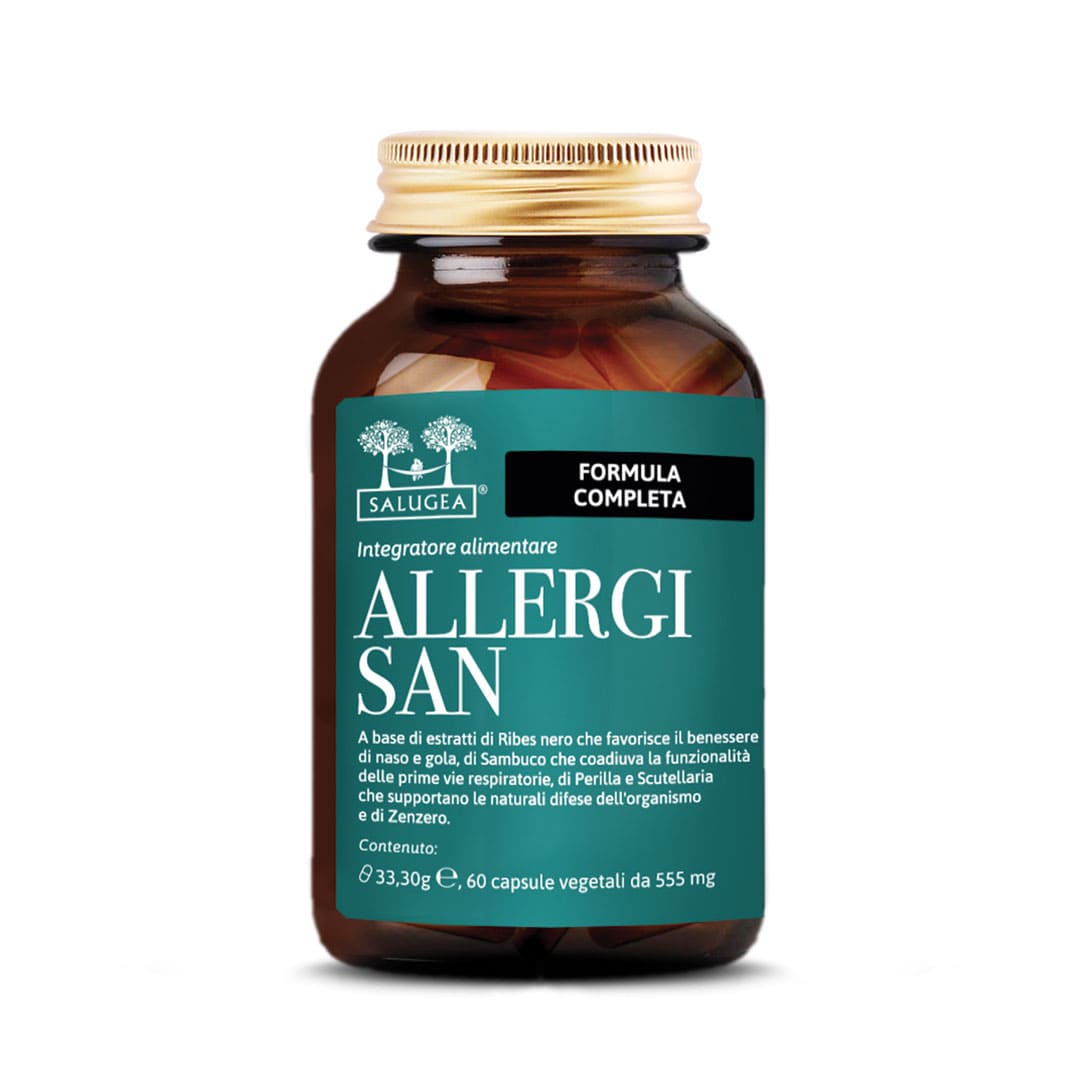
Allergisan’s formulation is innovative and complete.
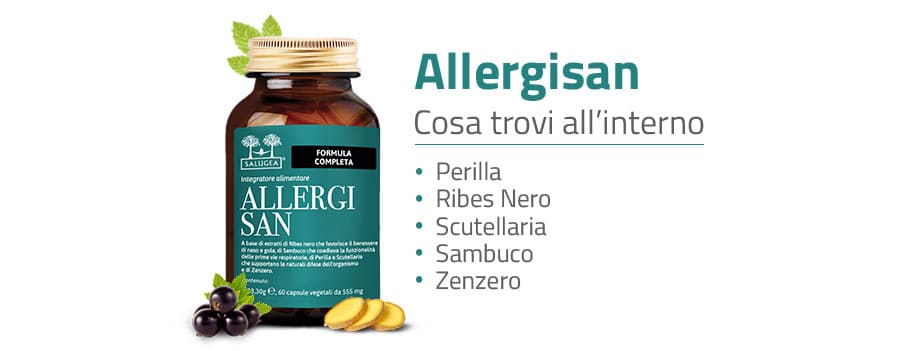
Perilla, Blackcurrant, Scutellaria, Elderberry and Ginger, as standardised dry extracts, allow you to act favourably on the balance of the immune system and the wellbeing of the throat and eyes, and to have a positive action against allergies (see the Experimental Phytotherapy section).
Useful both for prevention and as a prompt response.
Free from colourings, preservatives and sweeteners.
In the next section we will look at the specific scientific studies for each plant extract.
Experimental Phytotherapy
Perilla
Takano H, Osakabe N, Sanbongi C, Yanagisawa R, Inoue K, Yasuda A, Natsume M, Baba S, Ichiishi E, Yoshikawa T. Extract of Perilla frutescens enriched for rosmarinic acid, a polyphenolic phytochemical, inhibits seasonal allergic rhinoconjunctivitis in humans. Exp Biol Med (Maywood). 2004 Mar;229(3):247-54. doi: 10.1177/153537020422900305. PMID: 14988517.
This functional study set out to assess the effects of Perilla on people with allergic rhinitis. It involved 21 adults with allergic rhinitis, whose IgE levels and other blood concentrations were measured. At the end of the trial, the researchers found a significant reduction in symptoms and suggested Perilla as a useful adjuvant in these situations.
Jeon IH, Kim HS, Kang HJ, Lee HS, Jeong SI, Kim SJ, Jang SI. Anti-inflammatory and antipruritic effects of luteolin from Perilla (P. frutescens L.) leaves. Molecules. 2014 May 27;19(6):6941-51. doi: 10.3390/molecules19066941. PMID: 24871572; PMCID: PMC6271665.
In this study, carried out in vitro and in mice, the researchers examined the active ingredients of Perilla leaves in relation to rhinitis, asthma and inflammatory disorders. At the end of the investigation, a significant reduction in histamine levels and an improvement in allergic symptoms emerged, particularly with regard to itchy skin.
Scutellaria
Xu T, Ge X, Lu C, Dai W, Chen H, Xiao Z, Wu L, Liang G, Ying S, Zhang Y, Dai Y. Baicalein attenuates OVA-induced allergic airway inflammation through the inhibition of the NF-κB signaling pathway. Aging (Albany NY). 2019 Nov 6;11(21):9310-9327. doi: 10.18632/aging.102371. Epub 2019 Nov 6. PMID: 31692453; PMCID: PMC6874438.
In this study the researchers showed that Scutellaria has anti-inflammatory properties and can significantly reduce the airway hyper-reactivity that develops in allergic subjects. The researchers therefore suggest its use for patients with asthma and allergies.
Mao D, He Z, Li L, Lei Y, Xiao M, Zhang H, Zhang F. Recent Progress in Traditional Chinese Medicines and Their Mechanism in the Treatment of Allergic Rhinitis. J Healthc Eng. 2022 Apr 11;2022:3594210. doi: 10.1155/2022/3594210. PMID: 35444784; PMCID: PMC9015857.
In this review the researchers focused on the mechanisms of action and uses of Scutellaria, a plant used for centuries in ancient Chinese medicine in the treatment of allergic rhinitis. Attention is then turned to the drugs used for this problem, highlighting how their use is helpful but associated with significant side effects. In the review’s conclusion, Chinese natural remedies such as Scutellaria proved useful in reducing inflammatory cytokines and regulating IgE. Reductions in histamine levels were also found. The authors conclude that Scutellaria can be considered a valid support in the treatment of allergic rhinitis.
Ginger
Yamprasert R, Chanvimalueng W, Mukkasombut N, Itharat A. Ginger extract versus Loratadine in the treatment of allergic rhinitis: a randomized controlled trial. BMC Complement Med Ther. 2020 Apr 20;20(1):119. doi: 10.1186/s12906-020-2875-z. PMID: 32312261; PMCID: PMC7171779.
This clinical study involved 40 people suffering from allergic rhinitis. One group was treated with the drug, the other with ginger extract. At the end of the trial, both groups showed improvements in their symptoms, but those who took ginger reported fewer side effects, in particular drowsiness, fatigue, dizziness and constipation. The researchers therefore suggest that ginger extract could be used as an alternative treatment for patients with allergic rhinitis.
Kardan M, Rafiei A, Ghaffari J, Valadan R, Morsaljahan Z, Haj-Ghorbani ST. Effect of ginger extract on expression of GATA3, T-bet and ROR-γt in peripheral blood mononuclear cells of patients with Allergic Asthma. Allergol Immunopathol (Madr). 2019 Jul-Aug;47(4):378-385. doi: 10.1016/j.aller.2018.12.003. Epub 2019 Feb 10. PMID: 30745246.
The aim of this study was to assess the effects of taking ginger root on the immune cells in the blood of asthmatic patients. The research involved 50 people, half of whom suffered from a severe form of asthma. At the end of the trial, ginger extract was found to have led to an improvement in the blood profile and in symptoms. The researchers suggest that the use of ginger extract could control asthma and reduce the intensity of its manifestations by modulating the action of the main cell lines that can exacerbate asthma and airway symptoms.
Blackcurrant
Garbacki, N.; Angenot, L.; Bassleer, C.; Damas, J.; Tits, M. Effects of prodelphinidins isolated from Ribes nigrum on chondrocyte metabolism and COX activity. Naunyn. Schmiedebergs. Arch. Pharmacol. 2002, 365, 434–441, doi:10.1007/s00210-002-0553-y.
This study, conducted in animals, shows that the leaves of the Blackcurrant plant are capable of exerting decongestant and anti-exudative activity, and have also been shown to be able to inhibit the release of prostaglandins. These actions are truly fundamental in counteracting allergic reactions.
Dejima K, Ohshima A, Yanai T, Yamamoto R, Takata R, Yoshikawa T. Effects of polysaccharide derived from black currant on relieving clinical symptoms of Japanese cedar pollinosis: a randomized double-blind, placebo-controlled trial. Biosci Biotechnol Biochem. 2007 Dec;71(12):3019-25. doi: 10.1271/bbb.70413. Epub 2007 Dec 7. PMID: 18071252.
This double-blind clinical study involved 28 subjects with pollen-induced allergic rhinitis. Half of the subjects were treated with a placebo, the other half with Blackcurrant extract. At the end of the trial, the subjects treated with Blackcurrant showed a significant improvement compared with placebo across all symptoms (sneezing, itching, watery eyes, etc.) and generally reported a good improvement in their quality of life.
Elderberry
Hawkins J, Baker C, Cherry L, Dunne E. Black elderberry (Sambucus nigra) supplementation effectively treats upper respiratory symptoms: A meta-analysis of randomized, controlled clinical trials. Complement Ther Med. 2019 Feb;42:361-365. doi: 10.1016/j.ctim.2018.12.004. Epub 2018 Dec 18. PMID: 30670267.
In this review the researchers highlighted the mucus-thinning and mucolytic effects of Elderberry. They also suggest it as a possible alternative to the inappropriate use of antibiotics for upper respiratory symptoms due to viral infections, and as a potentially safer alternative, in terms of unwanted effects, to prescription drugs for routine cases of the common cold and flu.
Tiboc Schnell CN, Filip GA, Decea N, Moldovan R, Opris R, Man SC, Moldovan B, David L, Tabaran F, Olteanu D, Gheldiu AM, Baldea I. The impact of Sambucus nigra L. extract on inflammation, oxidative stress and tissue remodeling in a rat model of lipopolysaccharide-induced subacute rhinosinusitis. Inflammopharmacology. 2021 Jun;29(3):753-769. doi: 10.1007/s10787-021-00805-y. Epub 2021 Apr 21. PMID: 33881685.
This study, carried out in animals, aims to investigate the effects of Elderberry against inflammation, oxidative stress and tissue remodelling in the nasal and sinus mucosa. Several blood values were examined and, in conclusion, Elderberry extract proved useful in reducing the inflammatory response of the mucous membranes and in promoting the regeneration of inflamed tissues.
NOTES AND BIBLIOGRAPHY
1 Aït-Khaled N, Pearce N, Anderson HR, Ellwood P, Montefort S, Shah J; ISAAC Phase Three Study Group. Global map of the prevalence of symptoms of rhinoconjunctivitis in children: The International Study of Asthma and Allergies in Childhood (ISAAC) Phase Three. Allergy. 2009 Jan;64(1):123-48. doi: 10.1111/j.1398-9995.2008.01884.x. PMID: 19132975.
2 Nathan RA. The burden of allergic rhinitis. Allergy Asthma Proc. 2007; 28: 3-9.
3 Walker S, Khan-Wasti S, Fletcher M et al. Seasonal allergic rhinitis is associated with a detrimental efect on examination performance in United Kingdom teenagers: case-control study. J Allergy Clin Immunol 2007; 120: 381-387
4 see the Experimental Phytotherapy section for the Studies
5 Istituto Superiore di Sanità [Italian National Institute of Health] - EpiCentro - Asma [Asthma]
Our texts are for information purposes only; they are not to be understood as an indication for the diagnosis and treatment of medical conditions and are in no way intended to replace the advice of a doctor.