Up to 40% of the Italian population are estimated to suffer from IBS (Irritable Bowel Syndrome) at some point in their lives. Which means that nearly one person out of two experiences the effects of IBS.
This estimate - made by the Italian Society of Gastroenterology - reveals how common such syndrome can be.
IBS is a chronic disorder that affects the large intestine, with major consequences also on the mood and quality of life.
Let's see why.
People suffering from IBS experience:
- abdominal pain, at least once a week, over a period of at least three months,
- sudden pangs of pain followed by diarrhea,
- diarrhea or constipation, or alternation of both,
- discomfort that seems to go away after evacuation of stool.
The above symptoms have a high impact on the individual's daily life, both physically and emotionally. In fact, people suffering from IBS:
- experience permanent uneasiness away from home,
- have a very restricted diet (they eat only foods they consider as "safe"),
- always need to know there are restrooms nearby, whenever they are away from home,
- often feel tired and lack of energy,
- have tried several remedies, with no results.
And what are the solutions the market suggests?
Most of the supplements available on the market simply focus on temporarily stopping the urge to evacuate stools, which is fine for the occasional bowel discomfort, but in the long term the intake of such products can even make the discomfort worsen.
Even specific lactic acid bacteria (LAB) or probiotics can be of very little help, if none. In fact, if the bowel mucosa is irritated the strains of good bacteria will be hardly capable of colonizing the intestine, the irritated mucosa being inhospitable to them.
A correct phytotherapeutic approach should:
- help the intestine regain its physiological motility,
- provide the intestine walls with a lining that protects them,
- control intestinal hyper- or hypomotility,
- support the bowel mucosa regeneration,
- relieve stress and emotional strain.
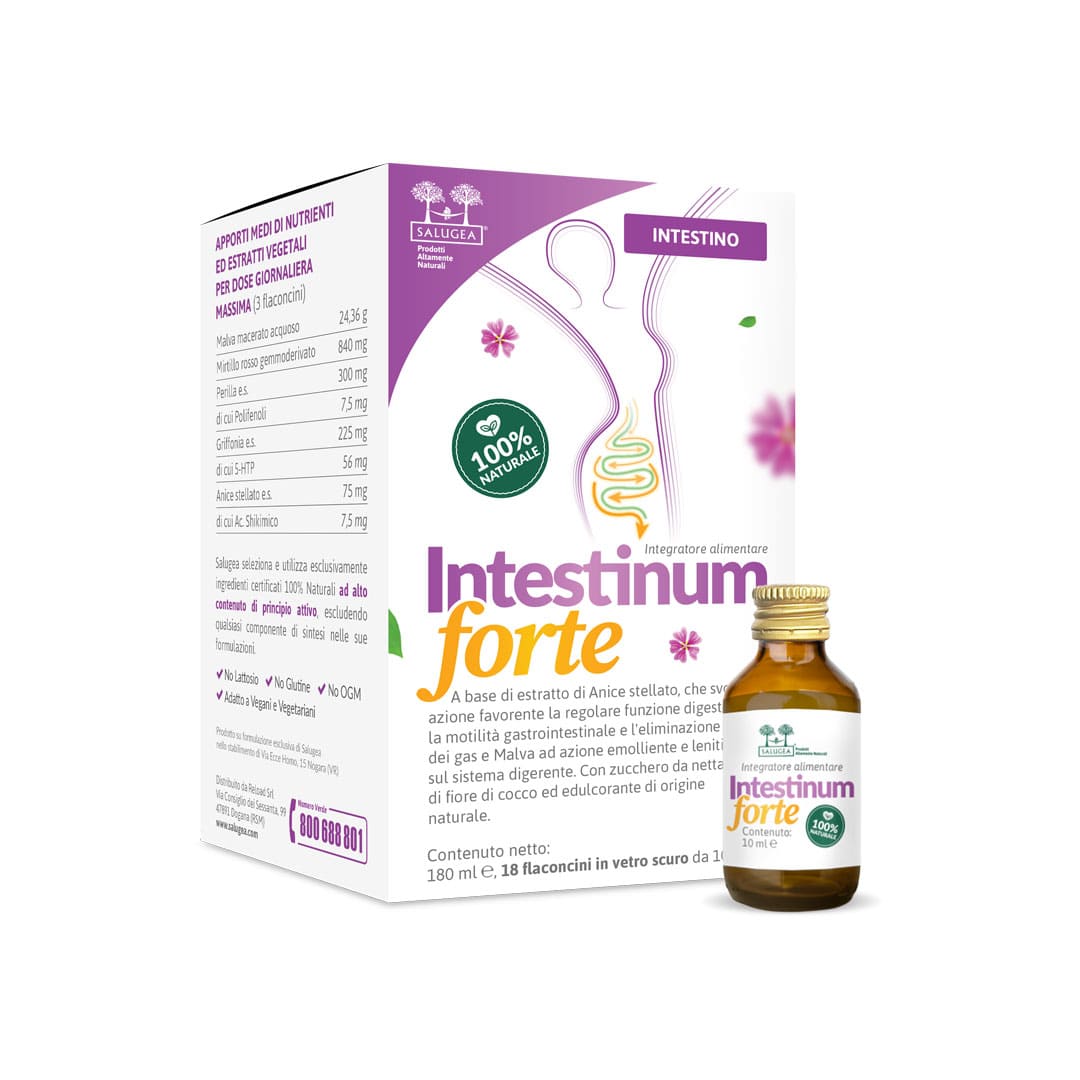
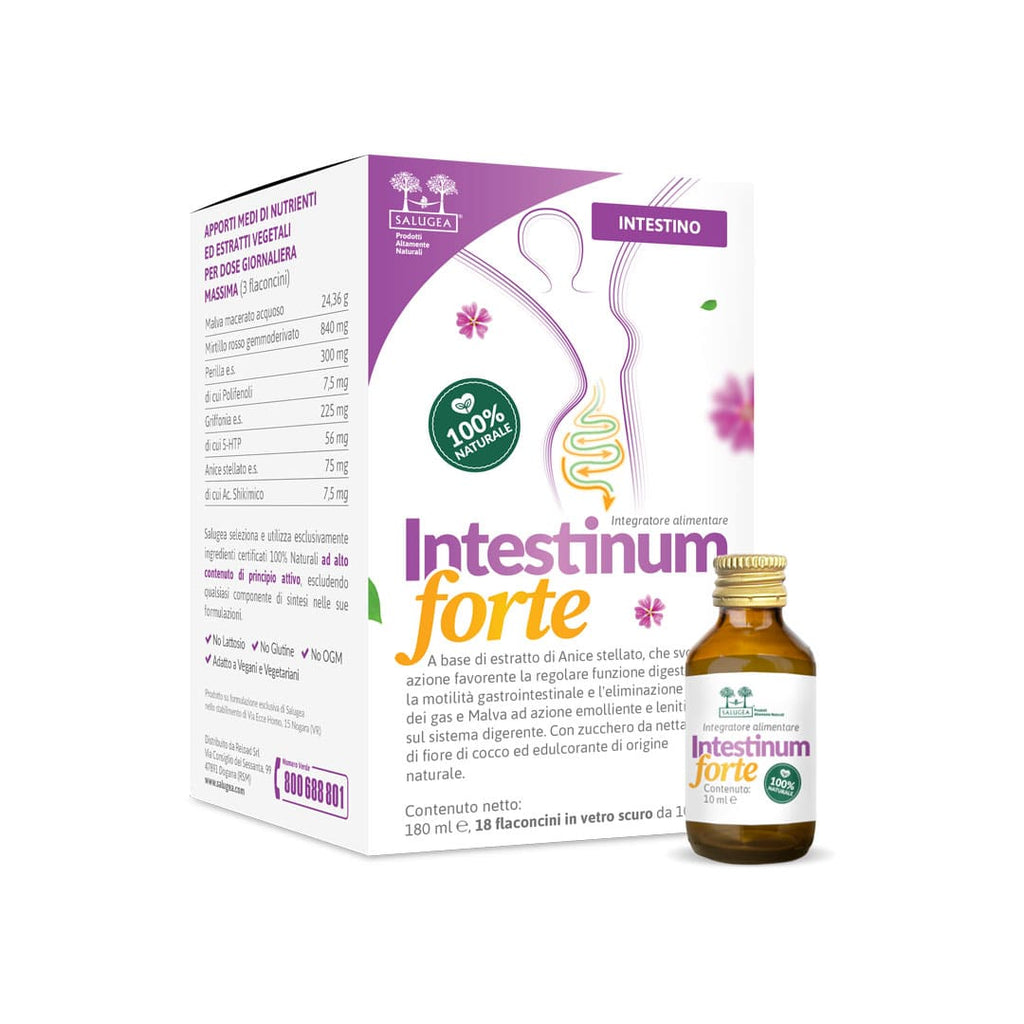
Based on these requirements, Salugea has created Intestinum Forte, a mix of natural ingredients that not only provide fast relief by regulating the enteric stimuli, but they are also effective on the long term by supporting the bowel mucosa regeneration and the control the intestine motility.
Besides, also the emotional side of the disorder is taken care of. It is a matter of fact that body, mind and environment are inextricably intertwined.
Experimental Phytotherapy
Mallow
- Mousavi SM et al. A Review on Health Benefits of Malva sylvestris L. Nutritional Compounds for Metabolites, Antioxidants, and Anti-Inflammatory, Anticancer, and Antimicrobial Applications. Evidence Based Complement Alternat Med. 2021 Aug 14; 2021: 5548404. doi: 10.1155 / 2021/5548404. PMID: 34434245; PMCID: PMC8382527.
The review considers various studies on Mallow therapeutical uses and benefits, highlighting its antimicrobial, epithelial barrier protective and antioxidant properties.
- Seddighfar M, Mirghazanfari SM, Dadpay M. Analgesic and anti-inflammatory properties of hydroalcoholic extracts of Malva sylvestris, Carum carvi or Medicago sativa, and their combination in a rat model. J Integr Med. 2020 Mar; 18 (2): 181-188. doi: 10.1016 / j.joim.2020.02.003. Epub 2020 Feb 7. PMID: 32113847.
In the study, focus was set on the analgesic properties of Mallow. The study - which was carried out on animals - confirmed that Mallow analgesic properties are effective in relieving intestinal discomfort.
Perilla
- Ahmed HM. Ethnomedicinal, Phytochemical and Pharmacological Investigations of Perilla frutescens (L.) Britt. Molecules. 2018 Dec 28; 24 (1): 102. doi: 10.3390 / molecules24010102. PMID: 30597896; PMCID: PMC6337106.
The review provides an overview of Perilla botanical, phytochemical and biological characteristics. Perilla specific properties were also analyzed. Perilla showed various biological activities such as antioxidant, antimicrobial, anti-allergic, antidepressant, anti-inflammatory and neuroprotection effects.
- Urushima H, Nishimura J, Mizushima T, Hayashi N, Maeda K, Ito T. Perilla frutescens extract ameliorates DSS-induced colitis by suppressing proinflammatory cytokines and inducing anti-inflammatory cytokines. Am J Physiol Gastrointest Liver Physiol. 2015 Jan 1; 308 (1): G32-41. doi: 10.1152 / ajpgi.00294.2014. Epub 2014 Oct 30. PMID: 25359539.
In this study, Perilla analgesic and soothing effects on colitis were studied. The study was carried out on mice and showed that Perilla active molecules induce a remarkable decrease in the body production of proinflammatory cytokines. That is why researchers conclude that Perilla might be useful in treatment and prevention of colitis.
Griffonia
- Keszthelyi D. et al. Serotonergic reinforcement of intestinal barrier function is impaired in irritable bowel syndrome. Aliment Pharmacol Ther. 2014 Aug; 40 (4): 392-402. doi: 10.1111 / apt.12842. Epub 2014 Jun 18. PMID: 24943480.
The study shows that alterations in serotonergic metabolism and/or intestinal integrity are associated with irritable bowel syndrome (IBS). 15 IBS patients and 15 healthy volunteers were involved in a randomised double-blind placebo-controlled study. At the end of the study, the researchers highlighted that serotonin can strengthen the intestinal barrier and this effect would be even more pronounced and positive in subjects with IBS.
- Garvin B, Wiley JW. The role of serotonin in irritable bowel syndrome: implications for management. Curr Gastroenterol Rep. 2008 Aug; 10 (4): 363-8. doi: 10.1007 / s11894-008-0070-3. PMID: 18627647.
In this review, the researchers analyzed the role of serotonin in IBS patients. Particularly, evidence that IBS is associated with perturbations in serotonin metabolism was addressed. Such evidence is fundamental to understand and treat IBS.
Star anise
- Xing JF, Sun JN, Sun JY, You CY, Dong K, Lv J, Dong YL. Protective effects of 3,4-oxo-isopropylidene-shikimic acid on experimental colitis induced by trinitrobenzenesulfonic acid in rats. Dig Dis Sci. 2012 Aug; 57 (8): 2045-54. doi: 10.1007 / s10620-012-2155-y. Epub 2012 Apr 3. PMID: 22476587 .
In this study, researchers investigate the effects and the protective mechanism of Star Anise on colitis induced in rats. At the end of the study, the scientists demonstrated the protective effect of shikimic acid on colitis, particularly on the large intestine mucosa, probably due to its antioxidant action.
- Wang GW, Hu WT, Huang BK, Qin LP. Illicium verum: a review on its botany, traditional use, chemistry and pharmacology. J Ethnopharmacol. 2011 Jun 14; 136 (1): 10-20. doi: 10.1016 / j.jep.2011.04.051. Epub 2011 Apr 29. PMID: 21549817.
This review summarizes the information concerning the botany, traditional use, phytochemistry and pharmacology of Star Anise. Star Anise has long been used in traditional Chinese medicine with the actions of dispelling cold, regulating the flow of Qi and relieving pain. The review has also taken into account other modern pharmacology studies confirming that Star Anise active compounds possess wide pharmacological actions, especially in antimicrobial, antioxidant, insecticidal, analgesic, sedative and convulsive activities.
DISCLAIMER
The content is not intended to be a substitute for professional medical advice, diagnosis, or treatment. Always seek the advice of your physician or other qualified health provider with any questions you may have regarding your medical condition.
I nostri testi hanno scopo divulgativo, non vanno intesi come indicazione di diagnosi e cura di stati patologici e non vogliono sostituirsi in alcun modo al parere del Medico.