Scientific Insights
Iron is one of the best-known elements for personal wellbeing.
The reason? It is involved in numerous bodily functions and reactions and becomes a key element for women's wellbeing especially during pregnancy and breastfeeding.
And that’s not all. Another reason why Iron is so crucial and so well known is its deficiency. Iron deficiency is called sideropenic anaemia, or iron-deficiency anaemia. According to the World Health Organization, anaemia is considered established (diagnosed) when blood haemoglobin levels are below 12 g/dL in women and 13 g/dL in men.
It is estimated that around 7% of men and 12% of women in the general population suffer from anaemia. These percentages rise considerably, however, during pregnancy or in the presence of heavy or frequent menstrual bleeding (20-50%).
Other age groups at risk include children and adolescents, pre-menopausal women, and the elderly.
The recommended daily intake of Iron for an adult is 14 mg, but it can rise to 30 mg in cases such as pregnancy, heavy periods, old age and debilitating conditions.
Before moving on, let’s dispel the myth about iron and diet.
Of course, our diet can provide us with a good share of iron, but it is wrong to believe that a deficiency can be made up through food alone. In fact, only 5-10% of the iron taken in with food is absorbed by the gut, unless it comes from meat in the so-called “haem” form, which is more readily assimilated.
This percentage drops considerably with a vegan or vegetarian diet, which calls for constant supplementation.
Besides conditions such as pregnancy, breastfeeding, heavy periods and dietary choices, there are other signs that may point to an Iron deficiency.
The most common are:
- frequent and prolonged headaches or migraines,
- pale complexion and pale mucous membranes,
- fatigue and exhaustion (asthenia) even at rest,
- difficulty breathing even in the absence of physical exercise (dyspnoea).
Other less frequent symptoms include:
- hair loss (alopecia),
- swelling of the tongue (glossitis),
- restless legs syndrome,
- dry skin, dry and brittle nails and hair,
- frequent mouth ulcers in the corners of your mouth,
- heart murmur,
- tachycardia,
- stress, decreased performance, lack of concentration (neuro-cognitive dysfunction),
- dizziness and tinnitus (when you experience ringing or other noises in one or both of your ears),
- spoon nails (Koilonychia).
And what about Vitamin B12?
Vitamin B12 is necessary for the development of the body, for the formation of healthy red blood cells and for the synthesis of DNA and myelin, the sheath that covers and protects nerve fibres.
Sufficient levels of Vitamin B12 are also important during pregnancy and breastfeeding as Vitamin B12 contributes to the normal development of the baby, and especially of his/her nervous system.
It is also essential for vegetarians and vegans, as it is practically absent from plant foods.
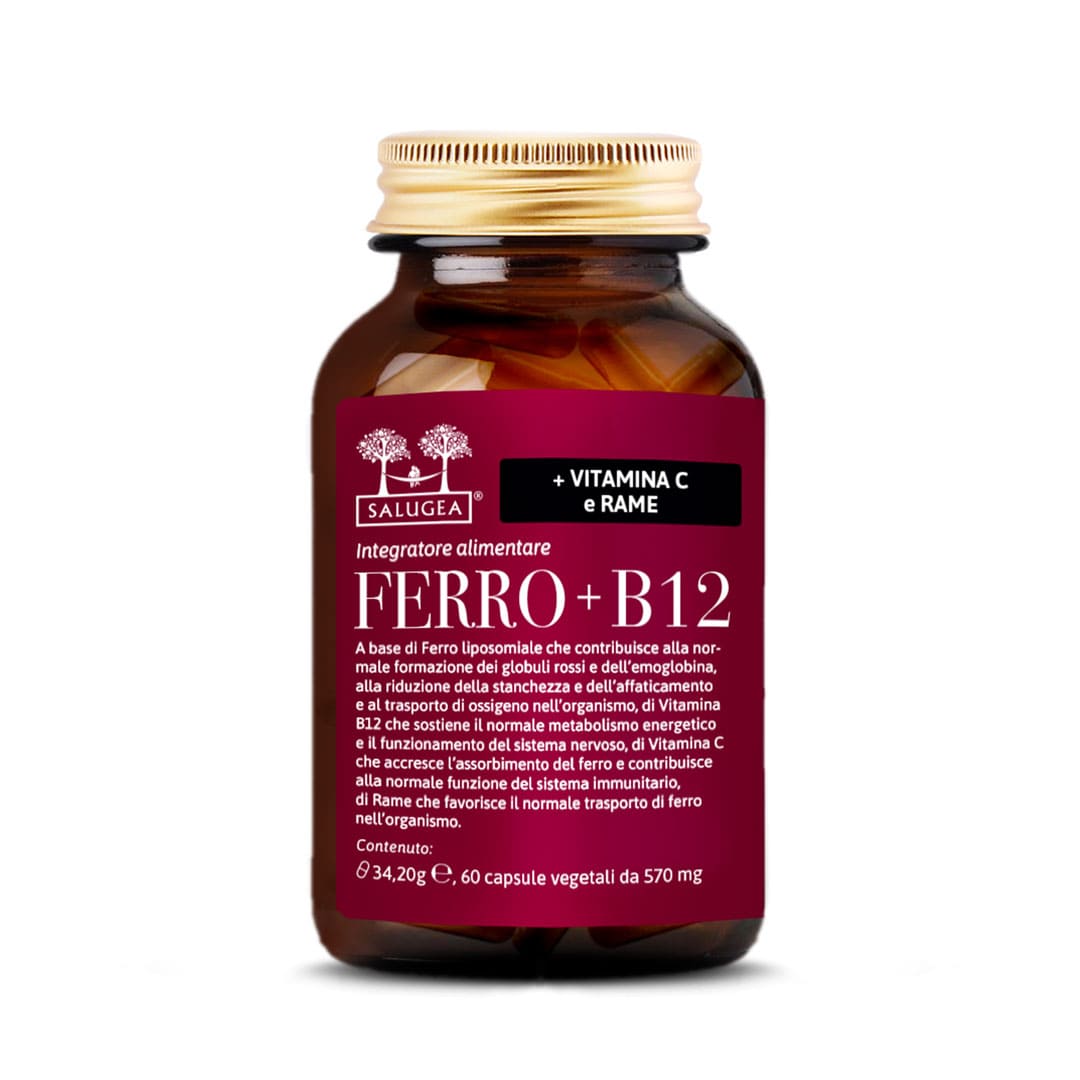
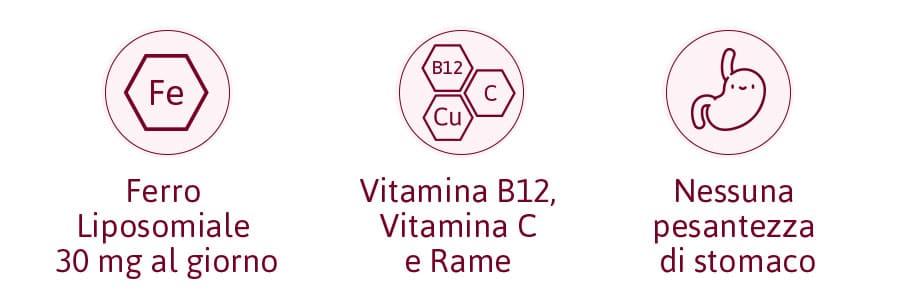
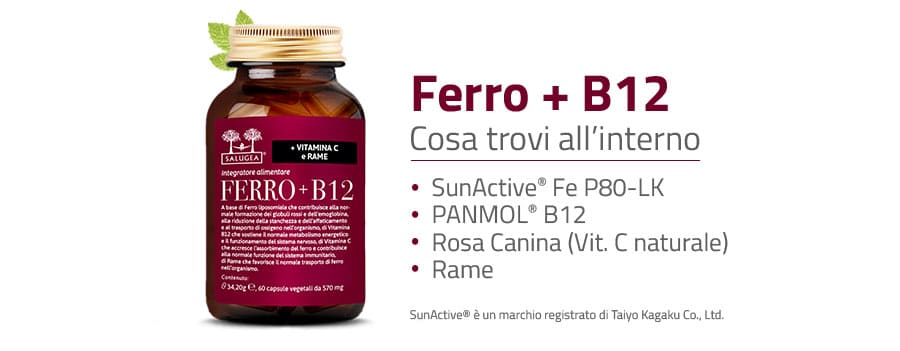
The mechanisms of Iron and Vitamin B12 are closely linked. That’s why at Salugea we have created a supplement that provides both, rigorously obtained from natural sources.
Alongside these, we also find Vitamin C (from Rosehip) and Copper, to promote the uptake and transport of Iron. Let’s now see what the scientific literature says about these active ingredients.
Experimental Phytotherapy
PANMOL® Vitamin B12
Zeuschner CL, Hokin BD, Marsh KA, Saunders AV, Reid MA, Ramsay MR. Vitamin B₁₂ and vegetarian diets. Med J Aust. 2013 Aug 19;199(S4):S27-32. doi: 10.5694/mja11.11509. PMID: 25369926.
This study highlighted Vitamin B12 deficiency in people following a vegetarian or vegan diet. The researchers suggest that those who follow these diets, or who limit their intake of animal-based foods, should supplement Vitamin B12 to avoid a deficiency. The authors also point out that Vitamin B12 deficiency has several stages and may be present even in people who are not anaemic. Particular attention is paid to vegan or vegetarian women during pregnancy. Vitamin B12 is in fact important for the correct development of the foetus.
Sucharita S, Dwarkanath P, Thomas T, Srinivasan K, Kurpad AV, Vaz M. Low maternal vitamin B12 status during pregnancy is associated with reduced heart rate variability indices in young children. Matern Child Nutr. 2014 Apr;10(2):226-33. doi: 10.1111/j.1740-8709.2012.00418.x. Epub 2012 May 24. PMID: 22625423; PMCID: PMC6860358.
In this study, the researchers highlighted how important Vitamin B12 supplementation is during pregnancy. They assessed nervous and cardiac activity in children born to mothers with low Vitamin B12 levels during pregnancy. At the end of the study, the researchers found that children born in these conditions showed reduced cardiac sympathetic activity.
SunActive® Fe-P80LK Liposomal
Houston BL, Hurrie D, Graham J, Perija B, Rimmer E, Rabbani R, Bernstein CN, Turgeon AF, Fergusson DA, Houston DS, Abou-Setta AM, Zarychanski R. Efficacy of iron supplementation on fatigue and physical capacity in non-anaemic iron-deficient adults: a systematic review of randomised controlled trials. BMJ Open. 2018 Apr 5;8(4):e019240. doi: 10.1136/bmjopen-2017-019240. PMID: 29626044; PMCID: PMC5892776.
This systematic review and meta-analysis of randomised controlled trials shows that Iron supplementation has positive effects on fatigue in non-anaemic iron-deficient adults. Iron supplementation has been associated with reduced subjective measures of fatigue and has significantly increased serum haemoglobin concentration.
Rioux FM, LeBlanc CP. Iron supplementation during pregnancy: what are the risks and benefits of current practices? Appl Physiol Nutr Metab. 2007 Apr;32(2):282-8. doi: 10.1139/H07-012. PMID: 17486170.
This article reviews current knowledge on the potential impact of iron supplementation during pregnancy on the outcomes of both infants and mothers. Based on the literature reviewed, an adequate daily dose of iron (30 mg of elemental iron) during pregnancy improves women’s iron status and seems to protect their babies from iron-deficiency anaemia.
Rosehip - vitamin C
Khoshfetrat MR, Mortazavi S, Neyestani T, Mahmoodi MR, Zerafati-Shoae N, Mohammadi-Nasrabadi F. Iron and vitamin C co-supplementation increased serum vitamin C without adverse effect on zinc level in iron deficient female youth. Int J Prev Med. 2014 Aug;5(8):1037-44. PMID: 25489453; PMCID: PMC4258673.
In this study, the researchers focused on Iron supplementation and the possible lowering of Zinc levels in young women. The aim was to assess what happened when Vitamin C was given together with Iron. The subjects were young women with iron deficiency. At the end of the study, the group that had also taken Vitamin C had increased its Iron levels and preserved its zinc stores better than the other group.
Thankachan P, Walczyk T, Muthayya S, Kurpad AV, Hurrell RF. Iron absorption in young Indian women: the interaction of iron status with the influence of tea and ascorbic acid. Am J Clin Nutr. 2008 Apr;87(4):881-6. doi: 10.1093/ajcn/87.4.881. PMID: 18400710.
Researchers evaluated the influence of the iron status of young women on iron absorption with tea or ascorbic acid. It has been demonstrated that ascorbic acid improves iron absorption, while tea exerts an inhibitory action.
Copper
Reeves PG, Demars LC, Johnson WT, Lukaski HC. Dietary copper deficiency reduces iron absorption and duodenal enterocyte hephaestin protein in male and female rats. J Nutr. 2005 Jan;135(1):92-8. doi: 10.1093/jn/135.1.92. PMID: 15623839.
This study - carried out in rats - confirmed that iron absorption in the intestines is diminished by a lack of copper in the diet.
DISCLAIMER. The content is not intended to be a substitute for professional medical advice, diagnosis, or treatment. Always seek the advice of your doctor or other qualified health provider with any questions you may have regarding your medical condition.
Our texts are for information purposes only; they are not to be understood as an indication for the diagnosis and treatment of medical conditions and are in no way intended to replace the advice of a doctor.